Canada Is Building Agricultural AI. For Whom?
Funding, data, validation, and public legitimacy.
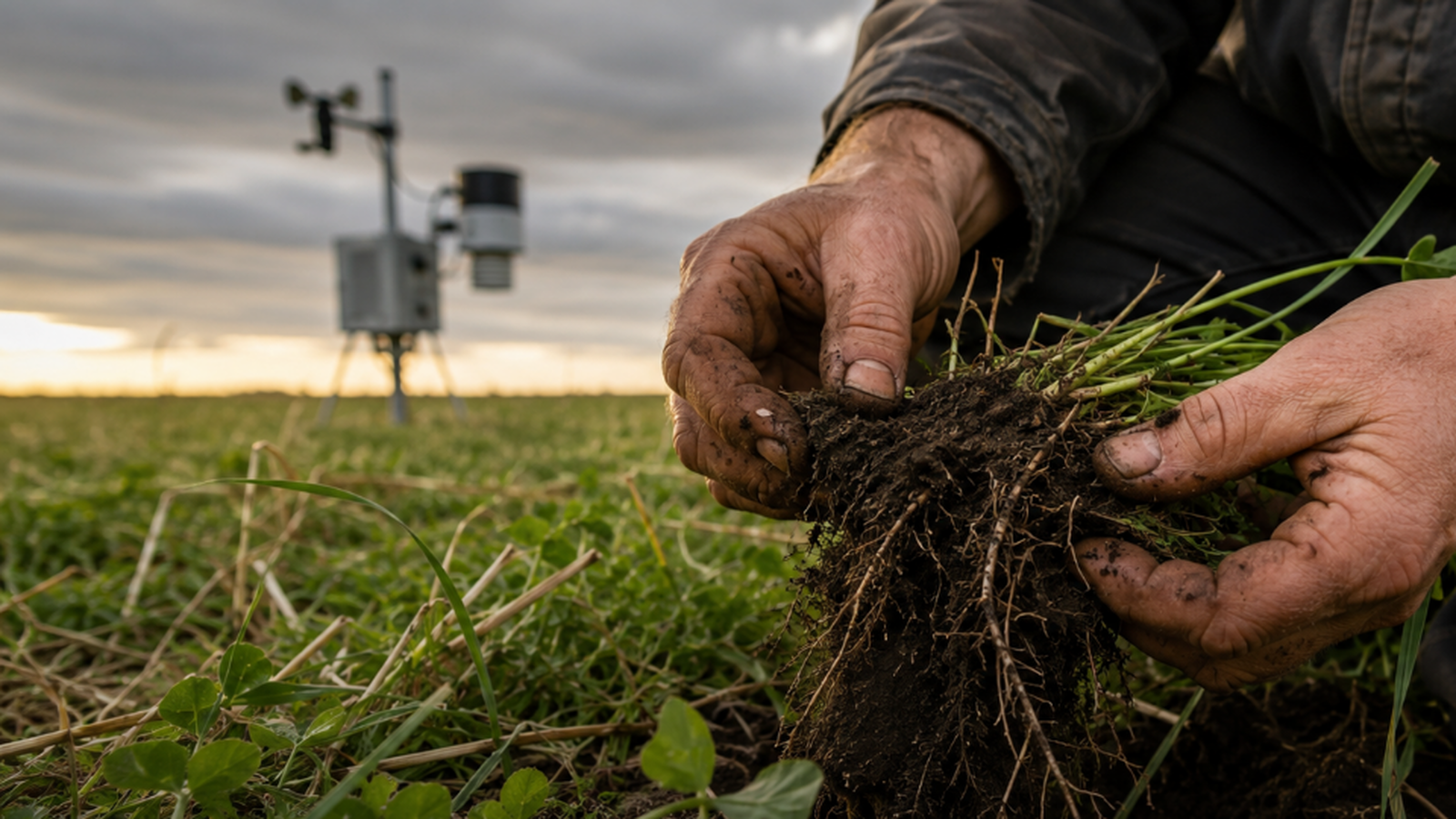
Canada is already building agricultural AI.
It is being built through federal funding programmes, test farms, research labs, equipment platforms, retail systems, rural networks, and the quiet work of people trying to make a tool useful before they are asked to trust it. Some of that work is public. Some is private. Much of it is mixed together.
The usual question is whether Canadian farmers will adopt AI. It is a reasonable question, but it arrives late.
First we need to ask who gets to build the systems around it. Who decides what data is collected, what counts as a successful trial, where a model runs, who can repair a broken connection, and what happens when a publicly funded project ends? Who can challenge a recommendation that arrives on a screen? Who gets a share of the value when the data came from their fields, barns, research plots, and communities?
Those questions are not a rejection of technology. They are the conditions under which technology becomes something people can live with.
Explore the research behind this case study: The Agrifood AI Field Guide is Metaviews’ public, searchable collection of source-backed research on how AI is being built, tested, governed, and lived with across food and agriculture. This case uses its global work as a lens on the Canadian choices now being made.
The country that is building and not yet using
The numbers produce an awkward picture. Statistics Canada reported in June 2025 that 1.8 per cent of businesses in agriculture, forestry, fishing and hunting had used artificial intelligence to produce goods or deliver services in the preceding 12 months. The figure across all businesses was 12.2 per cent.
That does not mean nothing is happening on Canadian farms. It does not even settle what “using AI” captures. A farm may be trying a product, using a sensor or platform whose AI component is invisible, or deciding that the tool is not worth the cost and risk. The figure is self-reported business use, not a complete portrait of farm-level experimentation, effectiveness, trust, or access.
Still, it tells us something important. Canada has activity without an obvious shared architecture.
The federal government funds AI supply-chain work through Scale AI, one of the Global Innovation Clusters. ISED says the cluster has received up to $284 million in federal funding. Scale AI's project portfolio has included agricultural work on crop health, insurance, orchard production, autonomous-agriculture data, local food supply chains, packaging, and retail forecasting.
That is a real public commitment. It is also a collection of projects, partners, and commercial ambitions. A portfolio is not automatically public infrastructure.
There is a difference between helping a company build a tool and giving farmers, researchers, communities, and Canadian institutions lasting capacity to understand and shape the system around that tool. There is a difference between paying for an experiment and keeping the knowledge, standards, support, and governance that make the experiment useful after the funding announcement fades.
This is where the politics begins. Public money is already choosing an agricultural-AI future. The question is what public return it expects.
What does a useful test look like?
Farmers have heard promises before. Better forecasts. Fewer passes through the field. Earlier disease detection. Less waste. More precise inputs. Sometimes the promise is real. Sometimes the expensive part is not the technology but the subscription, the integration, the training, the connectivity, or the time needed to discover whether a product is any good.
A healthy agricultural-AI system needs somewhere those claims can meet the world.
The Agriculture Innovation, Validation, and Adoption Network says it launched in May 2026 with a first cohort of nine multi-site projects, four validation hubs, and 23 Farmer Alliance members representing more than 235,000 acres in Saskatchewan and Manitoba. It brings together Farm Credit Canada, EMILI, the Wabash Heartland Innovation Network, test sites, and farmers. Its stated purpose is to evaluate technology under real conditions before it reaches wider market scale.
That is a promising idea because independent validation is more than a technical service. It is a form of respect. It says that a farmer should not have to take a vendor's word for it, or make a five-figure decision alone, or learn the hard way that a tool only worked in a sales demonstration.
But AIVA is new. Its first full growing season is underway, which means it should be judged by what it publishes later: methods, results, limits, failures, and the practical conditions under which a product did or did not work. A badge is not enough. The public interest is in the evidence it makes available, and in who has the power to ask the questions.
Olds College's Smart Farm offers a related Canadian model. Olds describes it as more than 3,300 acres across six locations in two provinces, used for commercial-scale applied research, including connectivity trials, remote sensing, autonomous equipment, data systems, and training. It is easy to treat a test farm as a backdrop for technology. It is more useful to see it as civic infrastructure: a place where claims can be tested, people can learn, and local conditions get to matter.
The country does not need every farmer to become a data scientist. It needs institutions that can make technical decisions less lonely and less opaque.
Open source is a capacity question
Open source belongs in this story, but not as a magic word.
Open code is not the same as open data. An interoperable interface is not the same as a farmer-controlled cooperative. A public database is not the same as community authority. A model that can be downloaded is not necessarily a model that a small organization can host, secure, maintain, evaluate, or adapt.
Those distinctions matter because the most consequential dependence often sits beyond the model itself. It is in the data pipeline, the cloud bill, the software connector, the licensing terms, the user interface, the maintenance contract, and the people who can answer the phone when something fails during a narrow weather window.
Mozilla's 2026 State of Open Source AI report makes a useful global point: the limiting factor is increasingly infrastructure, tooling, and governance around open models, rather than model quality alone. That is not a finding about Canadian farms. It is a warning against a shallow debate that asks only whether a model is open or closed.
For Canada, the better question is practical. Can a local research group, cooperative, Indigenous organization, farm network, or public institution inspect and improve the systems it depends on? Can it move its data? Can it keep operating if a vendor changes terms, leaves the market, or is bought by someone else?
Open source can make those options more possible. It does not make them free. Somebody still has to fund the maintainers, train the users, document the tools, protect the systems, and govern the data. If public institutions want local capacity, they have to pay for that work. Otherwise “open” can become another way of handing people a box of parts.
Data has a history and a home
Agricultural AI is often described as if data were raw material waiting to be collected. It is not.
Farm data is work. It comes from someone noticing a field, calibrating a machine, carrying a phone, repairing a sensor, making a judgment in bad weather, and living with the consequences if a recommendation is wrong. Research data also carries a history: the labour that produced it, the conditions under which it was collected, and the responsibilities attached to sharing it.
Vendor platforms regularly tell farmers that they own the information they upload. That matters. But ownership in a contract is not the whole question. Practical control includes whether a person can understand the agreement, see who has access, move data to another service, refuse a new use, repair the equipment that produces the data, and share in the value created from aggregation.
This is not a complaint about farmers using platforms. Many use them because the platforms solve real problems. The problem comes when a system offers a useful recommendation back to the farm while the wider patterns, market intelligence, and model improvements produced from pooled data remain elsewhere.
Canadian research has its own version of this problem. A Future Herd panel on dark data and edge computing brought agricultural researchers and practitioners together around the amount of observation that is collected, stored, and never responsibly reused. It is a perspective, not a settled measurement of the problem. But it names a live Canadian question. “Dark data” is not an invitation to throw open every archive. It is an argument for building trustworthy ways to decide what can be shared, for what purpose, under whose authority, and with what benefit returning to the people and institutions that generated it.
Indigenous data governance makes the stakes even clearer. Indigenous data sovereignty is not a privacy add-on for an existing system. It concerns authority, collective benefit, responsibility, and the right to determine how information about communities, lands, waters, and knowledge is used.
Canada has serious frameworks and institutions in this area. The CARE Principles articulate collective benefit, authority to control, responsibility, and ethics. OCAP® is specifically a First Nations framework. Inuit Tapiriit Kanatami's National Inuit Strategy on Research sets out distinct Inuit priorities for research governance, including Inuit access, ownership, and control over data and information.
Canada also has Indigenous-led and Indigenous-partnered work in food, monitoring, and AI-adjacent systems. It does not follow that a general Canadian AI programme has solved the funding and governance problem. The public question is whether Indigenous organizations have durable authority and dedicated capacity to build on their own terms, rather than having to fit their work into programmes designed for someone else's priorities.
No amount of source-code openness substitutes for that authority.
A different way to compare ourselves
Canada does not need to copy another country's system. It does need to see that different systems make different political choices.
In the Netherlands, JoinData is a farmer-controlled, non-profit data-sharing cooperative. A 2023 case study counted more than 16,000 farmer members. The model does not hold all farm data in one central repository. It gives farmers a way to manage authorizations and connect services. It emerged from a Dutch cooperative context that Canada cannot simply import.
Its value as a comparison lies elsewhere. JoinData asks a different question from a typical platform: not “how can the company obtain more data?” but “how can the farmer control who receives it?”
That is the sort of institutional design question Canada should be asking. So are these: What should be public? What should be cooperative? What should remain private? What should be locally maintainable? What must be governed by the communities whose data and knowledge are involved?
Those are not technical details. They determine whether an AI system feels like a useful instrument, another expense, or one more structure built around people without them.
What public policy should build
Canada does not need a grand national platform that tries to own every agricultural problem. It needs better terms for the systems public money already helps create.
First, public funding should purchase more than a pilot. Where it is appropriate, grants and procurement should require clear data-use terms, interoperability, exit and portability protections, documentation, and a plan for maintenance after the project period. This does not mean that every dataset must be open or that every company must give away its work. It means the public should know what durable capacity its money is buying.
Second, validation needs patient support. Test farms and applied-research institutions should be able to publish methods and useful results, including what failed and why. A farmer deciding whether to adopt a product needs more than a success story. Smaller operations, workers, and regions with poor connectivity need to be part of the testing question, not an afterthought once a tool has found its market.
Third, Canada should invest in shared stewardship. That includes rural connectivity, technical support, research-data governance, interoperable standards, and the unglamorous maintenance that lets a tool last. It also includes dedicated Indigenous-led agrifood-AI capacity and funding, with governance determined by the organizations and communities doing the work. A general eligibility rule is not the same as a route designed for Indigenous authority.
Finally, public institutions should be honest about where power sits. If a system depends on a proprietary platform, say so. If a model cannot be meaningfully inspected, say so. If an open-source tool still needs a funded host and a skilled maintainer, say so. People can make difficult choices when the terms are visible. They become rightly suspicious when those terms are hidden behind words like innovation, adoption, or efficiency.
Canada is building agricultural AI. The work is already underway.
Whether it becomes a system people can shape, trust, and benefit from depends on decisions that are being made now: in grant agreements, data contracts, test protocols, research partnerships, procurement rules, and community governance. The technology matters. So does the social world that decides who gets to live with it.
Sources and further reading
- Metaviews: Agrifood AI Field Guide
- The Future Herd
- Statistics Canada: Business use of AI as of second quarter of 2025
- Farm Credit Canada: AI could unlock a new era of growth for Canadian agriculture
- ISED: Canada's AI-Powered Supply Chains Cluster
- Farm Credit Canada: Root, your virtual farm assistant
- AIVA Network: launch announcement
- Olds College: Smart Farm & Research
- Mozilla: State of Open Source AI
- Development Gateway / USAID: JoinData case study
- Global Indigenous Data Alliance: CARE Principles
- First Nations Information Governance Centre: OCAP®
- Inuit Tapiriit Kanatami: National Inuit Strategy on Research