294: The Narcissism of the Possible
Against the Politics of Prediction
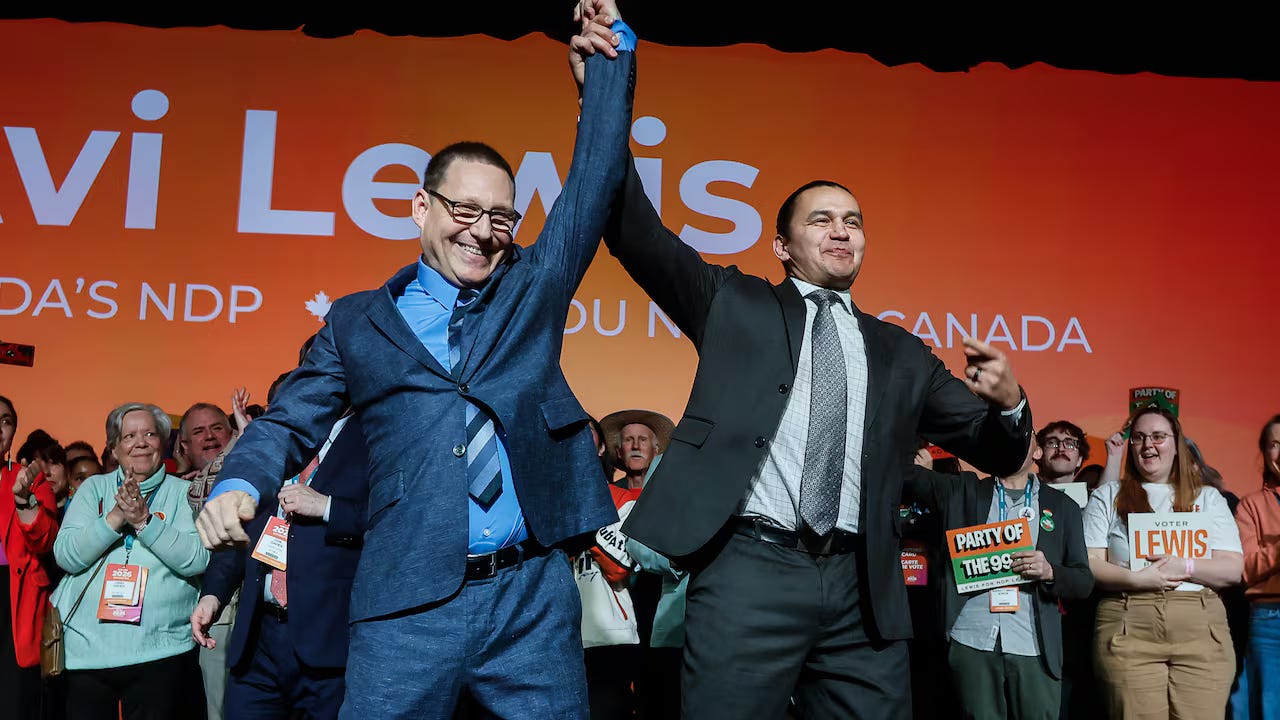
Avi Lewis was elected leader of the federal NDP, and within hours the reaction settled into a familiar rhythm: distance, dismissal, containment. Before a single policy speech, before a single parliamentary test, the question had already shifted from what he might do to whether he could be taken seriously at all.
This is how authority now gets negotiated in public. A rapid sorting process that decides which futures are allowed to feel plausible and which must be quietly ruled out. Tone arrives first. Substance, if it follows, does so inside a frame that has already done most of the work.
Avi’s victory is a signal. A party widely treated as marginal chose not to narrow itself further, but to elevate a figure associated with movement politics, redistribution, and a more confrontational stance toward concentrated power. Another moment might have opened a debate about direction, strategy, and renewal.
Instead, the dominant reaction has been pre-emptive.
Provincial leaders marked distance. Commentators reached for shorthand: ideological, unrealistic, elite, unserious. Online, the tone hardened into ridicule. The choreography was efficient. A boundary was drawn before any real contest of ideas could begin.
What we are seeing is less a disagreement than a refusal of possibility.
There is a structural reason for this. The NDP is not just electorally weak; it is epistemically fragile. When a party loses its grounding in public imagination, it compensates by narrowing its ambitions. It learns to survive by avoiding embarrassment, by speaking in a register calibrated to what already feels acceptable. Over time, this produces a defensive realism, where the horizon of political thought contracts to whatever can be justified in advance.
In that condition, a leader who gestures toward expansion becomes a problem to be managed.
The reaction is not about Avi Lewis as an individual. It is about the reappearance of political ambition in a system that has adapted to its absence. His leadership reintroduces the possibility that politics might still reorder material conditions rather than merely administer them. For those who have learned to operate within tighter constraints, this reads less as an opportunity than as a threat.
The speed of the backlash reveals something deeper about the current ecology of authority.
Authority is no longer secured primarily through expertise or institutional position. It is secured through anticipatory alignment with the dominant mood. The most authoritative voice is the one that most effectively signals what cannot be said, what cannot be wanted, what cannot be believed without inviting ridicule. Authority becomes the capacity to police the boundaries of the thinkable.
This is why narcissism matters, as a structural condition.
Political discourse has become saturated with forms of collective self-regard that are both inflated and fragile. Groups organize around identities that must be continuously affirmed and protected from dissonance. In such an environment, new political propositions are not encountered as arguments to be evaluated but as threats to status, coherence, and prior commitments.
The result is a style of engagement defined by preclusion.
Before an idea can circulate, it is categorized. Before it can be tested, it is mocked. Before it can gather support, it is framed as embarrassing. This is not simply incivility. It is a mechanism for maintaining equilibrium in a system that no longer trusts itself to deliberate openly.
Social media accelerates this dynamic, but it does not create it. Platforms reward speed, certainty, and emotional clarity, making them ideal vehicles for this kind of boundary enforcement. Mockery becomes a signal of belonging. Dismissal becomes a shorthand for competence. To hesitate, to entertain an unfamiliar possibility, is to risk misalignment.
In this context, narcissism operates not so much as individual vanity but as collective insecurity.
If politics is experienced primarily as a performance of identity, then the emergence of a figure who unsettles established scripts produces anxiety. The question is no longer whether the proposal is viable. The question is what its existence implies about those who did not propose it, who did not believe it possible, who adapted to a narrower field.
The reaction to Avi carries this undertone. It is not just that he might be wrong. It is that his presence reopens questions others had already closed.
This helps explain the intensity of the response. The sharper the contraction of political imagination, the more disruptive even modest expansions will feel. What appears as overreaction is often a sign of accumulated constraint.
The consequences for Canadian political discourse are already visible.
Debate is increasingly displaced by tone management. Parties in decline fear differentiation more than irrelevance. Media ecosystems, under pressure to maintain attention, default to frames that reward immediacy over inquiry. The result is a public sphere that struggles to hold open questions long enough for them to become productive.
In such a space, the future becomes difficult to articulate.
Prediction fills the vacuum.
Prediction markets, polling cultures, and algorithmic forecasting promise clarity without responsibility. They convert politics into a series of anticipated outcomes, privileging those who can read signals over those who can generate them. They reward alignment with what is already expected, while quietly disciplining those who attempt to shift expectations themselves.
This is the politics of prediction.
It narrows imagination by translating possibility into probability. It treats deviation as error. It invites participants to orient themselves toward what will happen, rather than what could be made to happen. In doing so, it reinforces the very constraints it claims to measure.
Against this, a different practice begins to emerge.
Reality preparation.
It does not ask what is likely. It asks what is possible, and under what conditions. It treats uncertainty as a field for inquiry rather than a risk to be hedged. It recognizes that authority, in this environment, flows less from having the right answers than from asking questions that reconfigure the space of answers.
Lewis’s leadership will be judged on many grounds: electoral performance, internal cohesion, policy development. Those metrics will matter. But they may miss the more immediate significance of this moment.
He has already triggered a reaction that reveals the current limits of Canadian political imagination.
The question now is whether those limits hold.
If the discourse continues to contract, his leadership will be contained, translated into familiar terms, or dismissed as an anomaly. The system will absorb the disturbance and return to equilibrium.
If the reaction itself becomes an object of inquiry, if its speed, tone, and structure are recognized as signals, then something else becomes possible. The conversation can shift from whether a particular leader is viable to how viability itself is constructed, enforced, and contested.
This restores the possibility of asking. You know, the power of the query.

@tashikann on TikTok These “No Kings” protests are just glorified photo ops so complicit sjws can position themselves higher than their general white counterparts. #nokings #protest #fyp #tashika #CapCut
Watch on TikTok