
284: Alto Sabotaged by Facebook NIMBYism?
Is it even possible to build infrastructure anymore?
Our last issue was an indicator that our agentic experiments and deployments have become a persistent draw on our attention. This has impacted our desired publishing schedule, and we’ll make attempts to get back on track.
However if you’re curious about agents, open source intelligence, and our related experiments, our Signal group chat acts as a kind of language laboratory with growing capabilities. To request membership email [email protected].
A quick synthesis of our agentic work: instead of personal assistants, what if agents are best described as personal governments?
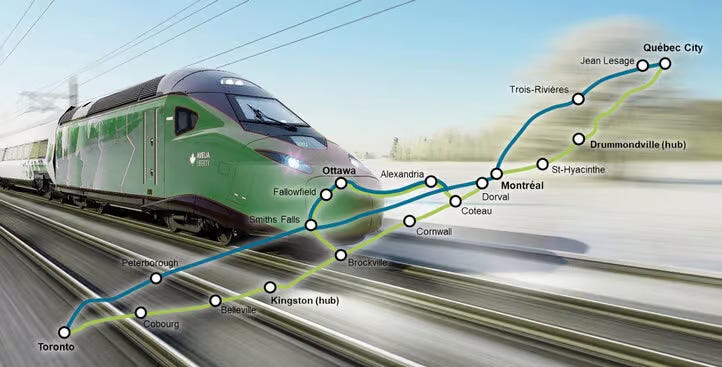
Southern Ontario has spent decades lamenting the lack of high speed rail infrastructure. Passenger trains in Canada are a pathetic afterthought, a neglected resources that ranks last when it comes to reliable transportation. We use rails owned by freight carriers, and regularly require buses to get passengers to their destination.
Amidst the repeated failures of the Ottawa LRT build, and the epic delays of the now open Eglington LRT in Toronto, we should regard Alto, the infrastructure project to build high speed rail, with significant skepticism.
For starters, they’ve initiated a public consultation that demonstrates they’re woefully unprepared to engage a conspiracy infused Canadian public.
The tragedy is that Alto is supposed to be about trains.
Faster trains. Cleaner trains. Trains that stitch Toronto to Montréal to Québec City in a way that finally feels like the 21st century.
Instead, it is becoming something else. It is becoming a test of whether Canada can still build anything big without tearing itself apart.
High-speed rail is not new. Countries from France to Japan have treated it as routine national infrastructure. In Canada, though, Alto arrives in a different climate, one marked by institutional fatigue, social media fragmentation, rural distrust, and a politics shaped less by deference and more by suspicion.
That is why Alto matters beyond transportation. It is a canary in the coal mine.
A Crisis of Trust
Over the past decade, large public projects have entered a new legitimacy environment.
The Government mistakenly believes authority is anchored in procedure: environmental assessments, hearings, consultations, parliamentary approvals. If the boxes are checked, the project proceeds. Opposition might persist, but the process itself carries weight.
Yet, procedure alone is insufficient.
Public authority is now evaluated in real time. It is judged not only by formal compliance but by narrative coherence. Residents ask:
Who benefits?
Who bears the cost?
Who was heard?
Was this decided already?
What aren’t they telling us?
Alto’s consultation phase reveals how quickly these questions surface. Before a preferred route is finalized, communities along potential corridors are mobilizing. Facebook groups form. Landowners calculate distances to hypothetical alignments. Elected officials are pressured to take positions.
Alta’s crucial mistake was to neglect or underestimate the role Facebook plays in both establishing authority and denying legitimacy. Facebook has become the informal consultation layer beneath the formal one.
Open houses and engagement portals represent institutional channels. Facebook groups represent ambient politics: emotional, immediate, decentralized. It is where residents compare notes, amplify fears, circulate maps, and share interpretations.
The platform accelerates cohesion among those who feel directly affected. A landowner in rural Eastern Ontario no longer feels isolated. Within hours, their concern becomes collective. Screenshots circulate. Claims harden.
The speed matters.
Consultation processes operate on bureaucratic timelines. Facebook operates on emotional timelines. When those tempos diverge, institutions appear slow, evasive, or reactive — even if they are technically following established procedures.
This is not unique to Alto. It is structural. Social media compresses distance between anxiety and organization. It produces early-stage resistance before planning stabilizes.
Infrastructure authority now competes with platform authority.
Misinformation as a Force Multiplier
Most destabilizing narratives are not elaborate conspiracies. They are simplified extrapolations.
Expropriation becomes “land grab.” Preliminary routes become “decided alignments.”
These claims gain traction because early planning phases are inherently incomplete. Where information is partial, imagination fills the gap.
The result is not necessarily false belief — it is distrust amplification.
Misinformation does not have to dominate discourse to shape it. It only has to introduce enough doubt that every official statement is treated as suspect. That doubt shifts the burden. Authorities must now prove legitimacy continuously rather than assume it.
For a project as large as Alto, that shift is consequential.
High-speed rail tends to be framed as a national good: economic integration, climate mitigation, productivity gains. These arguments resonate strongly in urban centres.
But alignment decisions occur in rural and peri-urban landscapes.
For landowners, farmers, and small municipalities, the project is not abstract. It is soil, fences, drainage, access roads, wildlife corridors, property values. It is about continuity of livelihood and identity.
If these communities perceive consultation as symbolic or reactive, opposition can move from technical concerns to identity defence.
That transition is critical. Technical disputes are negotiable. Identity disputes are not.
Once infrastructure becomes shorthand for central authority imposing on peripheral communities, compromise narrows. The project stops being about trains and becomes about autonomy.
That is the moment legitimacy fractures.
Alto is unlikely to collapse because of early backlash. Federal authority over interprovincial rail is strong. Expropriation law is well established. The state retains the formal capacity to proceed.
But formal authority is not the same as social license.
Projects in democratic societies survive not just because they can be built, but because they remain politically defensible over years of cost overruns, environmental review, and electoral turnover.
If Alto becomes a symbol of procedural opacity or disregard for local voices, it becomes politically expensive. Governments may still advance it — but at increasing reputational cost.
Infrastructure then shifts from nation-building to trust-draining. That is the deeper risk.
The Canary in the Coal Mine
Alto exposes a larger question:
Can Canada coordinate at scale in an era of distributed skepticism?
Large public works once reinforced institutional legitimacy. They demonstrated state capacity. They built common goods.
Today, every such project is also a referendum on governance.
If Alto adapts — by publishing route logic early, documenting dissent transparently, adjusting visible elements in response to feedback, and communicating constraints openly — it can strengthen legitimacy. Opposition becomes diagnostic rather than fatal.
If it does not, the signal is darker.
It would suggest that large-scale democratic coordination is becoming structurally unstable: not because citizens reject infrastructure, but because trust in process has eroded to the point where no project begins on neutral ground.
High-speed rail then becomes less about mobility and more about the limits of collective action.
The canary is not warning about trains.
It is warning about whether democratic authority can still build the future without first losing the present.

 Tiktok failed to load.
Enable 3rd party cookies or use another browser