
274: What if Trump just wants Alberta?
A province eager to become a red state?
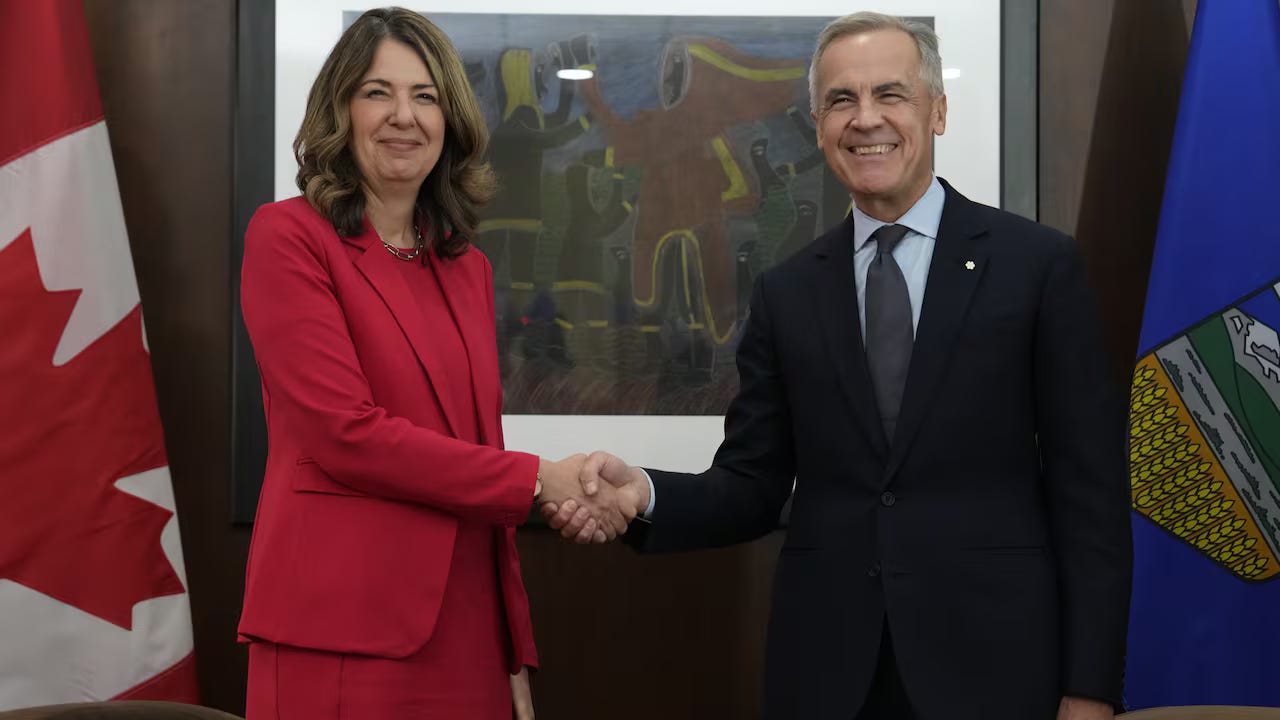
Trump’s threat to “take Canada” sounds unserious until you stop treating it as a territorial claim and start reading it as a stress test. He is not asking whether Canada can be conquered. He is probing whether Canada can hold itself together under pressure.
That distinction matters, because the fault lines are already visible.
There are credible reports of individuals in Alberta being paid to sign independence petitions, and of U.S.-linked money flowing into separatist media, organizing, and legal advocacy. This is not a mass movement, but it does not need to be. Modern destabilization works by manufacturing just enough legitimacy to keep institutions off balance. The goal is not independence tomorrow. It is ambiguity today.
Trump’s negotiating style thrives in that ambiguity. He does not require Alberta to leave Canada. He only needs Ottawa to believe that it might. Once that belief takes hold, every energy negotiation, every cross-border infrastructure deal, every emergency exemption becomes haunted by the possibility of internal fracture.
This is where Canada’s problem deepens. Alberta is not merely an economic engine; it is a symbolic one. It anchors national debates about energy, regional equity, climate policy, and fiscal redistribution. If Alberta were to drift further toward Washington rather than Ottawa, it would threaten Canada as we know it.
But Alberta is not the only pressure point.
British Columbia sits at the intersection of Pacific trade, ports, and energy transit. It is indispensable to LNG ambitions, vulnerable to U.S. shipping and rail leverage, and already entangled in disputes over pipelines and Indigenous jurisdiction. Any attempt to reorient Alberta’s energy flows inevitably drags BC into the conflict, whether willingly or not. Fracture rarely respects provincial borders.
Saskatchewan presents a quieter but no less consequential fault line. Its agricultural and resource economies are deeply exposed to U.S. markets, its political culture increasingly aligned with American populism, and its institutional capacity thinner than Alberta’s. It does not need to lead a break. It only needs to hesitate.
Then there is the North.
The Yukon, along with the broader Arctic, is where climate change, mineral extraction, and military logistics converge. As ice retreats, the strategic value of northern corridors increases. The U.S. already treats the Arctic as a shared defense space rather than a collection of sovereign territories. Any Canadian fragmentation elsewhere makes it easier to argue that northern governance should be “streamlined” in the name of security.
What makes this moment volatile is that many Canadians may not feel the same emotional attachment to Alberta that they do to the idea of Canada itself. There is a real risk that if Alberta is framed as perpetually aggrieved, obstructionist, or ideologically alien, large parts of the country may respond with fatigue rather than solidarity. “If they want to go, let them,” is not a fringe sentiment. It is a pressure valve—and a dangerous one.
Trump’s leverage lives there.
He does not need Canadians to cheer annexation. He only needs them to disagree about what is worth defending. If Alberta is recoded as a problem rather than a pillar, then its extraction—political, economic, or symbolic—becomes negotiable.
This is the deeper logic of Trump’s maximalist rhetoric. By claiming everything, he invites internal arguments over what matters most. By exaggerating his aims, he forces others to prioritize for him. The result is not conquest, but consent through exhaustion.
Canada’s vulnerability, then, is not military. It is relational. A federation survives not because its borders are inviolable, but because its parts continue to see value in one another—even when they disagree, even when redistribution feels unfair, even when identity frays.
If Trump wants Alberta, the real question is not whether the U.S. can take it. It is whether Canada still knows why it would refuse to give it up.
Tiktok failed to load.Enable 3rd party cookies or use another browser