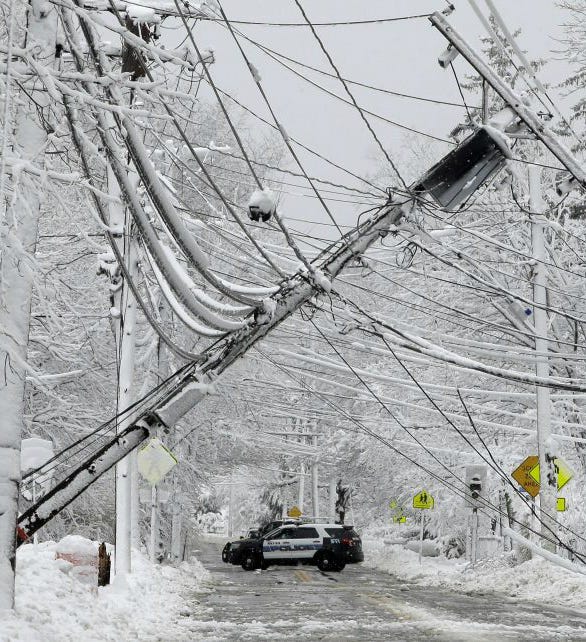
There is a storm approaching, and not just the one on the weather map. Ice is creeping across the American South and East, power grids are bracing, people are asking the oldest political questions in the most basic terms: will the heat stay on, will the food last, will help arrive in time. At the same moment, far from the frozen roads and darkened homes, politics is being performed at altitude, at Davos, in private rooms, among people whose greatest fear is not violence, but volatility.
That is where Mark Carney chose to speak this week, at the World Economic Forum, and the choice of venue matters as much as the words themselves. Davos is where politics now goes to speak seriously, because politics has become the exclusive domain of wealth. Not formally, not constitutionally, but functionally. Votes still exist, elections still happen, but the audience that truly matters is capital. The constituency that must be reassured is mobile, liquid, and ready to leave.
Carney understands this. That is what made the speech effective, and unsettling. He spoke to the wealthy in their own language: risk, instability, the breakdown of the rules-based order, the dangers of pretending that the old system still works. But he also performed a second, more delicate task. He offered the rest of us a story in which this rupture could be survived. A vision in which the storm would pass. A tone that suggested adult supervision still exists somewhere in the system.
This is the balancing act of contemporary authority: represent wealth without appearing captured by it; reassure the public without promising protection you cannot deliver.
The reaction to Donald Trump’s Greenland gambit made the underlying structure briefly visible. Trump did not back down because of outrage, or principle, or international law. He backed down because of the credible threat of capital flight: tariffs spooked markets, allies signaled instability, and money does not wait around for clarity. Sovereignty can be argued with. Capital simply leaves.
This is the quiet truth most political theater tries to conceal: the ultimate constraint on power is not protest, not even violence, but liquidity. Politics is allowed to be reckless right up until it threatens portfolios.
And yet, looming over all of this is the one force that does not negotiate with wealth: the weather.
Call it climate change, call it climate volatility, it doesn’t matter what you call it. Rich or poor, no one votes their way out of an ice storm. The wealthy can buy generators, battery walls, backup systems, private logistics. They can buffer themselves. They cannot opt out. Every storm is a reminder that the system we keep stabilizing in defense of wealth is increasingly misaligned with the conditions of the planet that sustains it.
This is where despair starts to accumulate.
We keep reacting to crisis, mistaking leadership that protects wealth, for leadership that anticipates shared vulnerability. We confuse aspirations of stability for foresight. We applaud speeches that soothe markets and then wonder why nothing feels secure at ground level. While leaders speak of resilience, millions are doing the math on heating bills, groceries, rent, calculations that have no margin left.
Politics, meanwhile, maintains the quality Bob Dylan once called idiot wind: loud, circular, self-referential, full of motion but going nowhere. The discourse howls across social media, exhausting itself in outrage and performance, while the material conditions continue to harden. We can gripe all we want online, but many of us have already been frozen out: of meaningful employment, of long-term security, of any real say in the direction of our society.
That is the deeper despair Carney’s speech both acknowledges and sidesteps.
He names the rupture honestly, but the system he is trying to stabilize is still one in which reassurance flows upward and risk flows downward. Davos is not where solutions for keeping the heat on are designed. It is where confidence is maintained long enough for capital to stay put.
The approaching storm makes this impossible to ignore. It collapses the metaphor into the material. As ice accumulates on power lines and supply chains strain, the distinction between abstract instability and lived precarity disappears. Wealth can delay the impact. It cannot abolish it.
And so we are left with a troubling recognition: leadership today is optimized to prevent capital from panicking, not to prevent people from freezing. We are told to take comfort in competence while being asked to accept exposure. Despair does not come from fear alone, it comes from sensing that the system is working exactly as designed, just not for us.
The storm will pass. They always do. But the weather of despair lingers, because it is not atmospheric. It is structural.