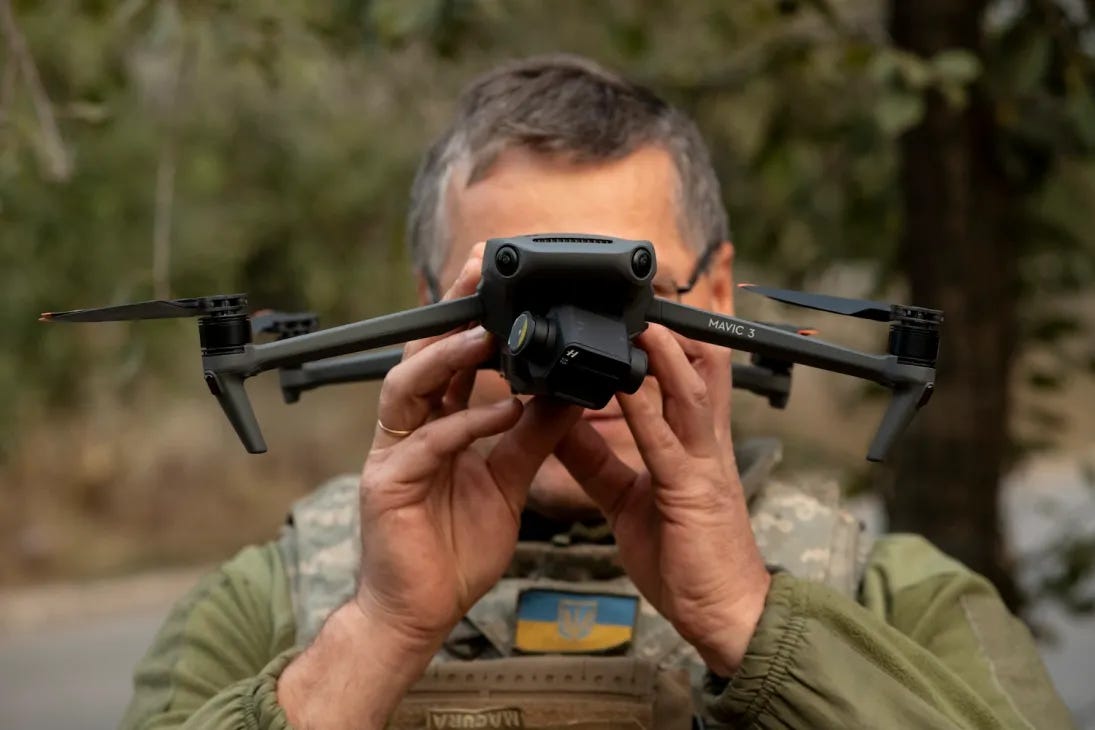
No. Not because they lack weapons or budgets, but because they are still designed for a world that no longer exists. Militaries remain trapped in an ableist ideology. One that assumes soldiers must be fit, strong, and “whole,” while wars today are increasingly fought in domains that reward perception, patience, pattern recognition, and distributed intelligence over physical might.
The archetype of the soldier as fit, obedient, and uniform is an artifact of industrial war. It emerged when bodies were machines, and warfare was measured by mass and momentum. But the wars of the present and future are hybrid, psychological, algorithmic. They unfold across screens and servers, in the skies above and the data below. They are fought by drones, hackers, propagandists, and automated logistics systems as much as by anyone carrying a rifle. The idea that only the able-bodied belong in the military is not only unjust; it is strategically self-defeating.
We say this not as outside observers, but as people who are disabled. We know firsthand how systems of exclusion waste the intelligence and potential of those deemed unfit. Disability is not a deficiency. It is a way of perceiving, organizing, and adapting. Those of us who navigate chronic conditions, physical limitations, or neurodivergent realities already operate in constrained and unstable environments. We learn to improvise, to sense beyond the obvious, to endure uncertainty. These are the very conditions of modern warfare. To exclude us is to deny the military access to one of the most resilient, adaptive, and perceptive sectors of society.
In this century, disability is not a disadvantage, it’s a form of adaptation. The able-bodied model of command assumes total control over one’s environment, but today’s battlefield is characterized by uncertainty, volatility, and asymmetry. Those who have lived their lives negotiating uncertainty are better equipped to lead in it.
The old military hierarchies still treat difference as deficiency. But the future of military and intelligence organizations will depend on radical inclusivity and transparency. Networks of participation rather than pyramids of control. A modern defense system must leverage the full diversity of human capacity. That means not only making room for disabled personnel, but recognizing us as essential to operational excellence. The future soldier might be someone with a prosthetic limb and a neural implant piloting autonomous systems from a kitchen table. The future officer might be neurodivergent, capable of seeing patterns and connections that conventional minds overlook.
Here in Canada, the stakes are becoming existential. The American threat is no longer hypothetical. The United States, consumed by internal conflict and authoritarian consolidation, increasingly looks north as a resource to be managed rather than a nation to be respected. Our defense posture was historically oriented toward peacekeeping and alliance maintenance and is ill-suited for this moment. We cannot win a conventional war against the U.S. military. But we could excel in an unconventional one. Our advantage lies in openness, adaptability, and the collective intelligence of our population.
And here is where our disability, as individuals and as a nation, becomes our strength. Canada has always been defined by asymmetry: vast land, small population, multilingual identity, fragile sovereignty. We have learned to live with limits. That humility can now be a form of power. Rather than pretending to match American firepower, we could embrace a distributed defense model, one built on citizen participation, digital coordination, and transparent intelligence. A model where the home, the workshop, and the community center become nodes in a national network of situational awareness.
As Ottawa rapidly increases military spending and reorganizes the reserves into a unified national defense force, there is an opportunity to rethink what defense actually means. A resilient nation is not one armed to the teeth but one organized through knowledge, participation, and trust. Rather than replicating American militarism, Canada could pioneer a defense model that draws strength from its people, all its people. A post-ableist force that sees every citizen as a potential node in a distributed defense network.
Ableism is obsolete because it misreads the nature of power. Power no longer resides in muscle or motion; it resides in cognition, cooperation, and code. Disability, redefined as a form of differentiated ability, is an asset. Those with physical limitations might control robotic systems; those with sensory differences might interpret drone feeds or signals in ways others can’t; those with mental or emotional divergences might anticipate adversaries’ motives with uncanny accuracy. The future battlefield is not the front line but the feedback loop.
If the Canadian Forces are to be effective in the decades ahead, they must move beyond compliance toward co-creation. They must stop filtering recruits through a 19th-century lens and start building a 21st-century network. That means embracing universal participation: opening military and intelligence organizations to everyone, regardless of physical or cognitive difference.
Disability is our future because it reflects the condition of our time: entangled, imperfect, adaptive, human. The age of the perfect soldier is over. The age of the collective defender: imperfect, inclusive, and interdependent has begun.