
242: The US Civil War of 2025
Understanding Hybrid Civil War
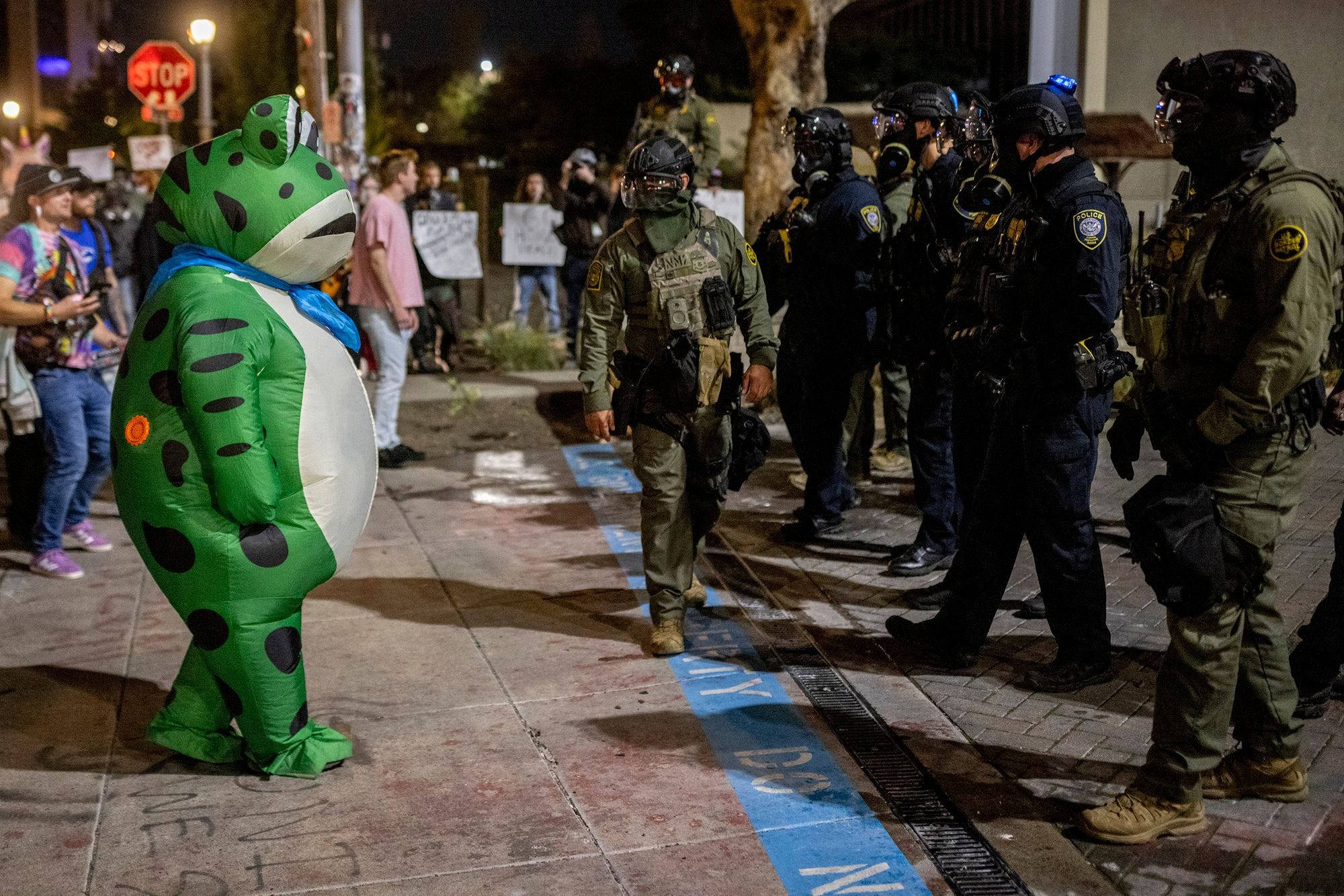
In our last issue we described the current state of authority in North America as being that of a hybrid war. However rather than a war between states, it is currently manifesting in the form of a hybrid civil war.
No declarations, no front lines. Only executive orders, court injunctions, and troop movements disguised as “mutual assistance.” Governors protest deployments they never approved. Federal agencies act without budgets. Families wait for food benefits that will not arrive. Each of these is an act of force. Each one, an assertion of authority over those who no longer recognize it.
What is unfolding across North America is not anticipation of conflict—it is the conflict itself. A hybrid civil war, distributed across jurisdictions, layered through institutions, fought not just for territory but for control of meaning and legitimacy. The appearance of order is the weapon. Chaos is the policy.
When the federal government shuts down, authority unravels. Yet rather than retreat, power metastasizes. Officials continue operations under emergency provisions, contracting loyal forces, bypassing appropriations, leveraging hunger and uncertainty as instruments of compliance. In this phase, the battlefield is procedural: who gets to act, who is recognized when they do, and who is left waiting while others improvise rule.
The hybrid nature of this war lies in its simultaneity. Legal warfare through injunctions and lawsuits. Information warfare through staged briefings and algorithmic repetition. Economic warfare through withheld aid and selective enforcement. Paramilitary warfare through ICE and the selective federalization of the National Guard—units deployed across state lines, against local objections, under ambiguous command. Each domain feeds the others. Together they form a system of coercion without the need for victory.
This is what a dual state looks like when it stops pretending. The normative order—the one bound by constitutions and statutes—continues to issue statements, file motions, and hold hearings. But beside it operates the prerogative order: the chain of loyalty, the network of emergency powers, the armed apparatus ready to enforce directives regardless of law. Both claim to represent the republic. Both believe they are legitimate. The difference is that one still asks permission, and the other no longer needs to.
As social programs come to a halt and SNAP benefits begin to evaporate, the economy of survival turns political. Food banks become sites of authority, where scarcity disciplines more effectively than law. The spectacle of charity replaces the substance of welfare. The hungry are told to be patient; the well-fed are told to be vigilant. The line between crisis management and counterinsurgency narrows until it disappears. How far are we from mass looting of food and basic supplies?
What follows is not collapse but consolidation. A state learning to govern through emergency. A population learning to live with contradiction and conflict. A federation rehearsing fragmentation in real time.
From a distance, it looks like dysfunction. Up close, it is occupation.
The hybrid war is not declared because it cannot be contained. It operates through ambiguity, thrives on confusion, and advances by forcing everyone to choose sides before they understand what the sides are.
Traditional wars depend on boundaries. Hybrid wars dissolve them. Every institution becomes a potential front. Every procedure a weapon. Every citizen a target or a signal. The lines of battle are drawn through supply chains, data centers, court dockets, and news cycles.
North America has entered this phase because it has lost coherence. Power no longer flows vertically; it circulates through networks, contractors, and factions that operate with partial autonomy. Each claims to act in defense of order, while competing definitions of order multiply. The result is a war against complexity.
Hybrid warfare blurs the distinction between internal and external conflict. The tactics once exported to foreign battlefields—disinformation campaigns, sanctions, proxy militias, lawfare—have returned home. Federal agencies frame domestic unrest as insurgency. States frame federal overreach as occupation. The people are told to trust none and fear all.
Information is the primary theatre. Legitimacy is manufactured algorithmically, then reinforced by spectacle. Social platforms amplify every contradiction until exhaustion replaces engagement. The fog of war is now perpetual, updated hourly, trending by design.
Economic warfare complements this fog. A shutdown is more than a budget failure—it is a siege. Federal workers unpaid, benefits suspended, food withheld, infrastructure delayed. Each delay erodes faith in the state’s capacity to govern. Each erosion strengthens the actors who benefit from crisis. Scarcity, not abundance, is the currency of control. Especially as the military is funded by private donations from billionaires.
Hybrid war demands participation. Silence is interpreted as opposition; neutrality is punished as disloyalty. Journalists are accused of sedition. Courts are labeled partisan. Civil servants are forced into loyalty tests disguised as audits. The administrative state becomes a battlefield of narratives, where procedures double as traps.
What makes this phase dangerous is that it feels ordinary. The headlines still describe politics. The broadcasts still use the language of governance. But beneath the surface, authority has become transactional. Orders are obeyed not because they are lawful, but because disobedience has consequences. This is how hybrid war stabilizes—through fatigue, uncertainty, and the normalization of emergency.
For those inside the system, the priority is survival. For those outside, it is interpretation. Both are forms of submission. The goal is not victory but acquiescence: to make citizens grateful that the war is only half-visible, and that their suffering still has rules.
From Canada, the war seems near yet also far. We tell ourselves the war is not here, not yet, but in that we’re mistaken. The question is not whether we are at war, but what kind of war we’ve been dragged into. It’d be easy if it was a war against an other, an invader, yet the conflict is coming from inside.
Our instinct is to watch, not intervene. To treat American instability as spectacle, or at most as an economic concern. But the border is porous in ways we no longer admit. Data, disinformation, capital, and despair flow north as easily as weather. When the United States fractures, its energy does not stop at customs.
The hybrid war is already leaking across systems we share. The same infrastructure that moves trade also moves narratives. The same algorithms that mediate their politics mediate ours. We are not immune; we are integrated.
This demands preparation, not panic. Not the militarized kind—the humanitarian kind. Communities must plan for disruption, not invasion. For the disappearance of goods, the overflow of refugees, and the contagious logic of emergency. The test will not be whether Canada remains peaceful, but whether it remains at all.
Authority, in this context, means restraint. It means refusing to mirror the tactics of control that dominate the hybrid war next door. It means defending procedure when procedure seems slow, and insisting on transparency when secrecy is the easiest option. Our challenge will be to hold space for deliberation while the noise grows unbearable.
The American civil war of 2025 is not a beginning or an end. It is a transition—the formal dissolution of a political order that has been dying in plain sight. Hybrid warfare is not a strategy. It is a symptom of power that no longer believes in itself.
What comes next will not be decided by generals or governors, but by the capacity of ordinary people to organize meaningfully amidst systemic confusion. If authority survives, it will do so in the places where trust and truth still intersect.
The future of authority will not be written in Washington or Ottawa, but in how we respond to the noise—whether we echo it, or whether we build something quieter, slower, and harder to control.
Tiktok failed to load.Enable 3rd party cookies or use another browser