“Generals gathered in their masses
Just like witches at black masses
Evil minds that plot destruction
Sorcerer of death’s construction...” — Black Sabbath, War Pigs (1970)
Next week’s gathering at Quantico of nearly every general and admiral in the U.S. military is being cast as an exercise in authority. War Secretary Pete Hegseth is calling in the top brass for what he insists is a routine address about discipline, grooming standards, and the so-called “warrior ethos.” But the optics are obvious: this is about spectacle.
It is a show designed for television, for news cameras, for later clips that will flood timelines with images of solemn officers seated before their Secretary, unified in their silence. Hegseth doesn’t just want to be heard — he wants to be seen with the generals, to prove through visual association that he is in command.
The timing is no accident. Xi Jinping just staged another dazzling military parade in Beijing, a performance of might and loyalty, choreographed to remind both his people and the world of the Party’s dominance. Hegseth, and by extension the Trump administration, is jealous of this. They want their own parade — not of tanks and missiles down Pennsylvania Avenue, but of generals in uniform, lined up obediently in an auditorium.
Yet beneath the surface, the reality is far less unified.
Morale among officers is shaky. Firings and cuts at the senior ranks have spread anxiety. Abrupt decisions, often political in tone, have left commanders second-guessing their own standing. The officer corps has not forgotten that Hegseth is an outsider, a cable-news pundit turned political appointee. Respect is shallow. Trust is thin.
And crucially, there are not enough loyal officers to mount the kind of purge that would consolidate power in the way authoritarian regimes of the past once managed. The numbers simply aren’t there. The ranks of generals and admirals may fill a hall at Quantico, but they do not form a coherent bloc of loyalty to Trump or Hegseth. Theirs is the obedience of protocol, not belief.
This is theatre. A play staged at the expense of the very people it seeks to impress. A Secretary of Defense summoning his officers to perform as extras in his made-for-TV tableau. A gesture that underscores not strength, but insecurity.
The historical comparisons practically write themselves. Commentators are quick to draw analogies to Nazi Germany, to Reichstag purges and military subjugation under fascism. The parallels are not wrong — but they may be incomplete.
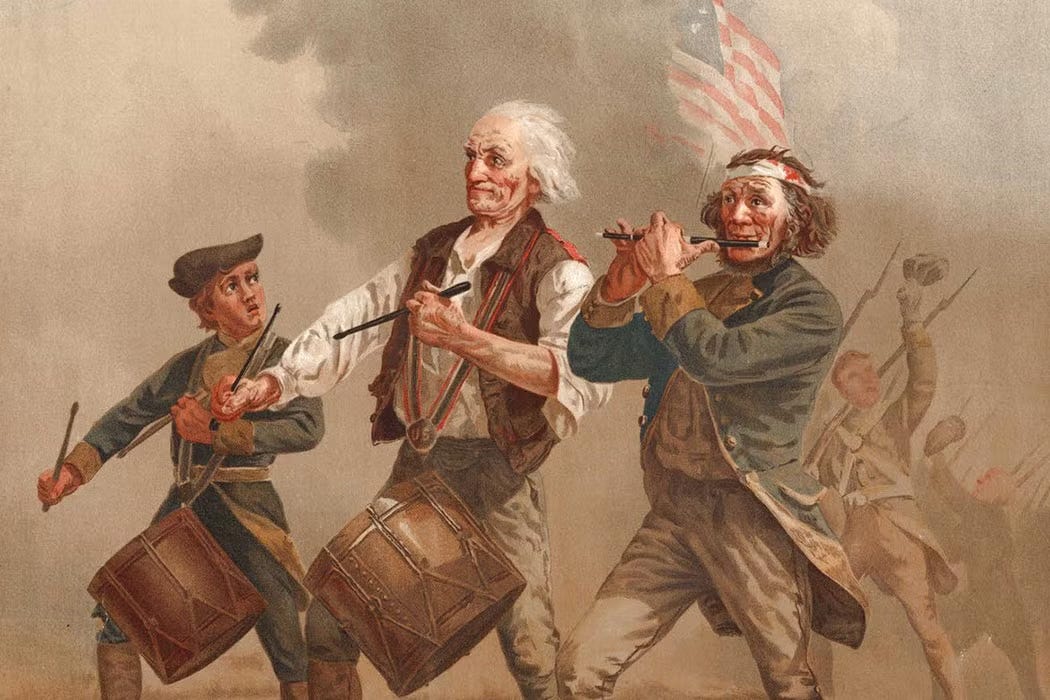
What if the closer analogy is not the 1930s in Berlin, but the 1770s in Boston and Philadelphia?
A society where institutions fray under the weight of tyranny. A government that demands loyalty while offering little legitimacy. A population facing economic and political volatility, where allegiance to authority fractures.
The Revolutionary War began not as a tidy separation from empire but as a messy, chaotic rejection of rulers who had lost the consent of the governed. The spectacle of British redcoats marching in formation through colonial streets was meant to project strength. Instead, it revealed weakness: a ruling power so insecure it relied on display rather than legitimacy.
Today’s Quantico gathering risks the same effect. The more Hegseth insists upon the spectacle, the clearer it becomes that authority itself is slipping.
The danger for Hegseth is that spectacle can backfire. A hall full of generals does not project unity if the nation senses unease behind their eyes. History teaches that when rulers rely on theatre, it is often because their authority is already slipping.
Spectacle without substance becomes parody. And parody in politics is corrosive — it undermines the very legitimacy it seeks to build. The Quantico gathering risks becoming one of those moments that, in hindsight, reveals weakness rather than strength. A Secretary desperate to be feared, instead seen as insecure. An administration that wanted to project command, but instead displayed fragility.
Trust is the real currency of authority. Once it collapses, institutions can stagger on for a time, but their foundations are already crumbling. The Revolutionary era was born not from a single declaration, but from years of eroded trust — colonists no longer believed the Crown could govern them fairly. Today, that same collapse of belief is underway.
If Quantico marks anything, it is not the consolidation of a new order but the fraying of the old. A revolutionary era does not always announce itself with banners and battle cries. Sometimes it begins with silence — with the gap between the spectacle on stage and the disbelief in the audience.