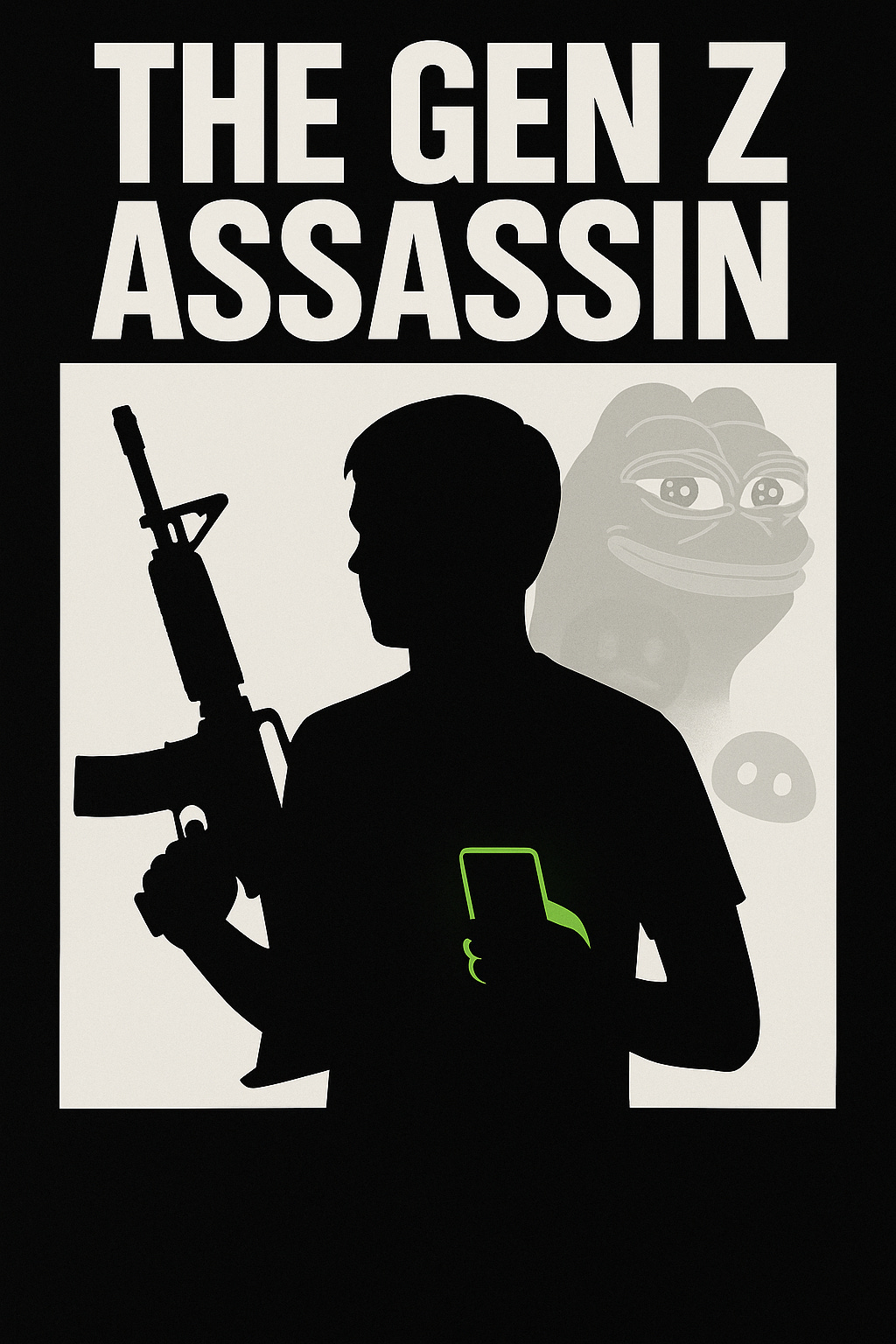
The American Republic has always been soaked in blood. From Lincoln to Kennedy, from Huey Long to Allard Lowenstein, the line of fire has never been far from the center of political life. Political assassination is not an aberration, it is a tradition — a ritual reminder that authority in the United States is never as secure as it pretends to be.
The killing of Charlie Kirk at a Turning Point USA event is being narrated, predictably, as senseless violence. The press casts Tyler Robinson as an antifascist lone wolf, the authorities hint at left-wing radicalization, and both seek refuge in the idea that this was an external shock, an unexplainable rupture. But this is the wrong story. The state and the media have it backwards. Robinson was no antifascist. He was not a left wing rebel striking at a demagogue. He was, unmistakably, a child of the far right, shaped by its memes, its discords, its accelerant despair.
He was a Groyper. Not a card-carrying party member — there are no cards, no parties — but part of a swarm. His bullet casings were etched with jokes only the terminally online would recognize, the kind of ironic nihilism that Groypers thrive upon. “Hey fascist! Catch!” is not the language of a principled antifascist militant, it is the taunt of a troll steeped in accelerationist black pill ideology. This is the aesthetic of despair turned to action, where memes are mantras and killing is content.
To insist otherwise, to pin this killing on the left, is to indulge a familiar American game: blame the antifascists so that fascism itself can advance. Every act of violence becomes a pretext for repression, and every assassin is recast as a terrorist from the wrong side of the spectrum. In truth, the far right is eating its own. The Groypers despised Charlie Kirk. They built their brand by humiliating him in public, by exposing him as the empty vessel of “Conservative Inc.” Robinson was simply the first to follow the logic through to its bloody end.
This is not just politics. This is generational. Gen Z has no patience for civility. Their ideologies are born in meme forges, shaped in Discord servers, radicalized by ironic laughter and despair. They are black-pilled by climate collapse, economic precarity, and endless culture war. For them, politics is not a platform but a performance — and assassination is the ultimate performance, the moment when meme and martyrdom fuse.
America has always celebrated its assassins. Booth was a hero to the Confederacy. Oswald became the vessel for a thousand conspiracy theories. Sirhan Sirhan was mythologized, Hinckley became a pop icon. Every shooter is vilified in the courtroom but immortalized in the culture. That is the paradox the Republic cannot resolve: violence is condemned, yet woven into the mythos of the nation.
What the state cannot yet fathom is the rise of the Gen Z assassin. Not so much left or right, but raised on feeds that blur the two. Ideology is no longer a coherent doctrine but an algorithmic drift toward extremity. Every scroll is a radicalization, every meme a manifesto. This is why the old categories fail. Tyler is not the antifascist they want him to be, but neither is he the patriot they will fear him as. He is something else: a creature of the Internet, a product of the nihilist swarm.
We should be wary. Not because assassination itself is new — it is not — but because the conditions that breed this kind of violence are multiplying. The black pill is spreading. The Groypers and their kin are accelerating. And when their violence is miscast as the work of antifascists, fascism gains license to grow stronger.
The Gen Z assassin is not an outlier. He is a harbinger. And the question America should be asking is not why it happened, but how many more will follow.