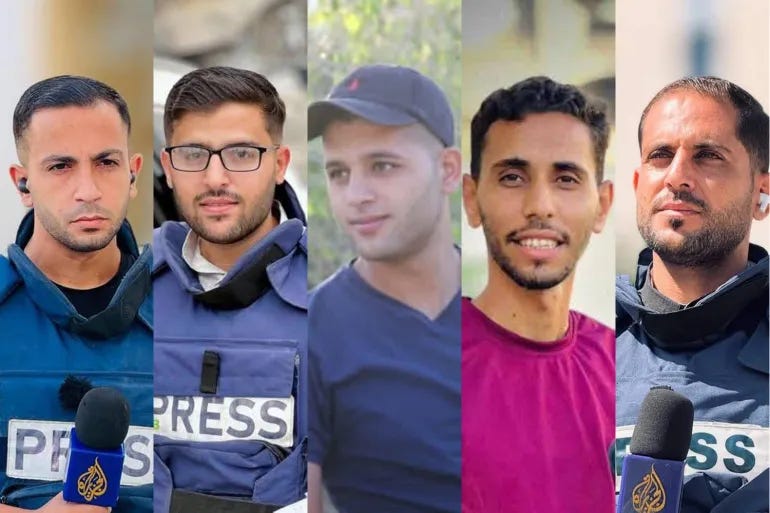
The tent outside Al-Shifa Hospital was meant to be a fragile pocket of safety. Journalists gathered there to file stories, recharge their battered cameras, catch their breath before plunging back into the wreckage. It was not a fortified position, not a military outpost, just a place where the people whose job is to look could sit for a moment without running. On August 10, 2025, the Israel Defense Forces made sure they could never get up again. Anas al-Sharif, a voice and a lens for Al Jazeera in Gaza, was killed alongside four of his colleagues in an instant of steel and fire. Their bodies were pulled from the ruins, their cameras left crushed in the dust, their last files lost to the smoke.
Al-Sharif’s face was known far beyond Gaza. For months he stood in front of bombed-out apartment blocks and hospitals, speaking into the chaos, telling the world what was happening with the calm authority of someone who understood that bearing witness is both a duty and a danger. His voice was steady even when the air behind him was split by explosions. His reporting was unflinching, not because he was reckless, but because he knew the stakes: if no one tells the story, the story disappears.
That disappearance is the point. The IDF claimed, as they have so many times before, that al-Sharif was a Hamas operative. It is a sentence that, in the official record, functions as both verdict and execution order. No evidence is necessary, no court will sit in judgment, no neutral body will weigh the facts. It is a label that transforms a journalist into a permissible target. To the people who knew his work, to those who watched him hold a microphone instead of a rifle, the claim is as hollow as the ruins they found him in. But the allegation does its job—it muddies the record, gives cover to those who prefer not to care, and erases one more witness from the field.
This is not new. Gaza has become the most dangerous place in the world for journalists, and the killing has been systematic. More than 180 reporters have been killed since October 2023, their deaths explained away with the same recycled accusations. Al Jazeera has been singled out for years, harassed, banned, accused of incitement, because its audience is too large, its reach too broad, and its coverage too unwilling to fit into the frame approved by the state. When you cannot control the image, you destroy the camera.
Killing a journalist is more than an act of violence—it is an act of erasure. It cuts the chain of custody between reality and the record. It turns the truth into a rumour. Without witnesses, atrocities become allegations, and allegations can be dismissed. This is not just a military strategy; it is a philosophy of control. In this logic, territory matters less than narrative. Occupying a land is temporary; occupying history is forever.
The outrage came quickly. The United Nations condemned the strike. The European Union expressed its horror. The Committee to Protect Journalists demanded justice. Statements were issued, vigils held, headlines written. And then the war moved on. The cameras panned elsewhere. The absence of al-Sharif’s voice became just one more gap in a chorus of silenced voices. The impunity remains intact. The killings will continue.
This is the future being built in real time: a world where killing the witness is a prelude to burying history. Where the space between what happened and what will be remembered is patrolled by states willing to kill to keep it empty. In such a world, those who dare to look become the front line. Those who dare to speak become combatants in the war over reality itself. And every time a witness is murdered, the rest of us are pushed further into the dark.