
227: THE GOATS OF TORONTO 🐐
Municipal Ruminants and the Future of Urban Ecology
Tomorrow, Wednesday August 6th we’ve got our salon on the power of language. Email [email protected] to get the link to participate! The Metaviews Signal group has been discussing the power of language already, here’s a quote:
A fugitive community could be a pretty cushy way to spend the rest of your life.
How a herd of municipal ruminants reshaped the city
Part I — The Day the Goats Returned
The first time Khadija saw a goat on the subway, she didn’t even blink.
The animal wore a neon vest — CITY LIVESTOCK: GOAT #14 - CLOVER — and stood calmly beside a compost cart packed with wilted produce. A teenager in city green held the leash, tapping through a checklist on a battered tablet. No one on the train looked twice. Goats had become normal.
It had only been eighteen months since the pilot began — quietly at first, in the backyards of East York and the schoolyards of Parkdale. The “Goat Urban Integration Initiative” (GUII, pronounced gooey by its critics and gwee by its fans) had started as a wildfire prevention measure along the Don Valley. Then someone realized the goats could eat food waste. Then someone else realized they made people happier. Then they just… stayed.
Now every ward had at least one grazing route. Kids walked them before school. Retirees coordinated their shifts on WhatsApp. Public compost bins were being phased out in some neighborhoods — replaced by feed troughs and rotational drop sites.
Khadija ran a café near Pape and Gerrard. She paid into the local Goat Guild and got organic waste pickup in return. Two goats came by every second morning, managed by a young neighbor she barely knew before this all started. They grazed on her overgrown garden, took her wilting lettuce, and left behind perfectly pelletized manure for her tomatoes.
It wasn’t perfect. Not every neighborhood had adjusted. There had been complaints — dog chases, fence breaches, a goat nibbling on an unattended sleeve of Timbits. But the City had released clear bylaws, training videos, and community insurance options.
It wasn’t just that the goats cleaned things up. They slowed things down. Made people look. Smile. Talk. They reminded the city that it didn’t have to be all asphalt and noise. That something different was possible — and already happening.
And they were doing it without permission from Queens Park.
Part II — The Right to Ruminate
A Manifesto from the Urban Ecology Working Group
April 2026
We do not inherit the city from our ancestors. We cohabitate it with the living.
Why Goats, Why Now
Toronto is in crisis:
Our compost system is failing under volume and contamination.
Green space is shrinking while maintenance costs rise.
Mental health crises are surging.
Kids have never been more disconnected from nature.
And we still act like goats are the problem?
In August 2025, a coalition of urban ecologists, neighborhood co-ops, and frontline sanitation workers launched the Goat Urban Integration Initiative (GUII) to test what would happen if we legalized, supported, and integrated goats into the city’s public infrastructure.
Within a year, we proved that goats could:
Clear invasive plants faster and cheaper than city crews.
Reduce organic waste by up to 32% in pilot zones.
Create new youth employment programs.
Strengthen neighborhood networks and informal care systems.
Deliver visible, tangible climate adaptation people can believe in.
The Ask
We demand that goats be recognized as:
Public Workers, not pets.
Ecological Partners, not property.
Urban Kin, not novelty.
We call for:
Zoning Reform — End blanket bans on livestock. Create a municipal licensing pathway for herd-based waste, land, and care work.
Goat Guilds — Fund local cooperatives to manage care, logistics, conflict resolution, and youth training.
City Support — Allow access to public land (parks, lots, ravines). Provide infrastructure (shelters, feed bins, watering stations).
Legal Protection — Recognize goats as municipal workers with protections against abuse, exploitation, or displacement.
The Philosophy
Goats remind us that we are not separate from the land. They chew what we discard. They fertilize what we pave. They form bonds that break through our alienation. Goats are not the future — they are the present, if we choose it.
Toronto is already changing.
It’s time our policies caught up with our people.
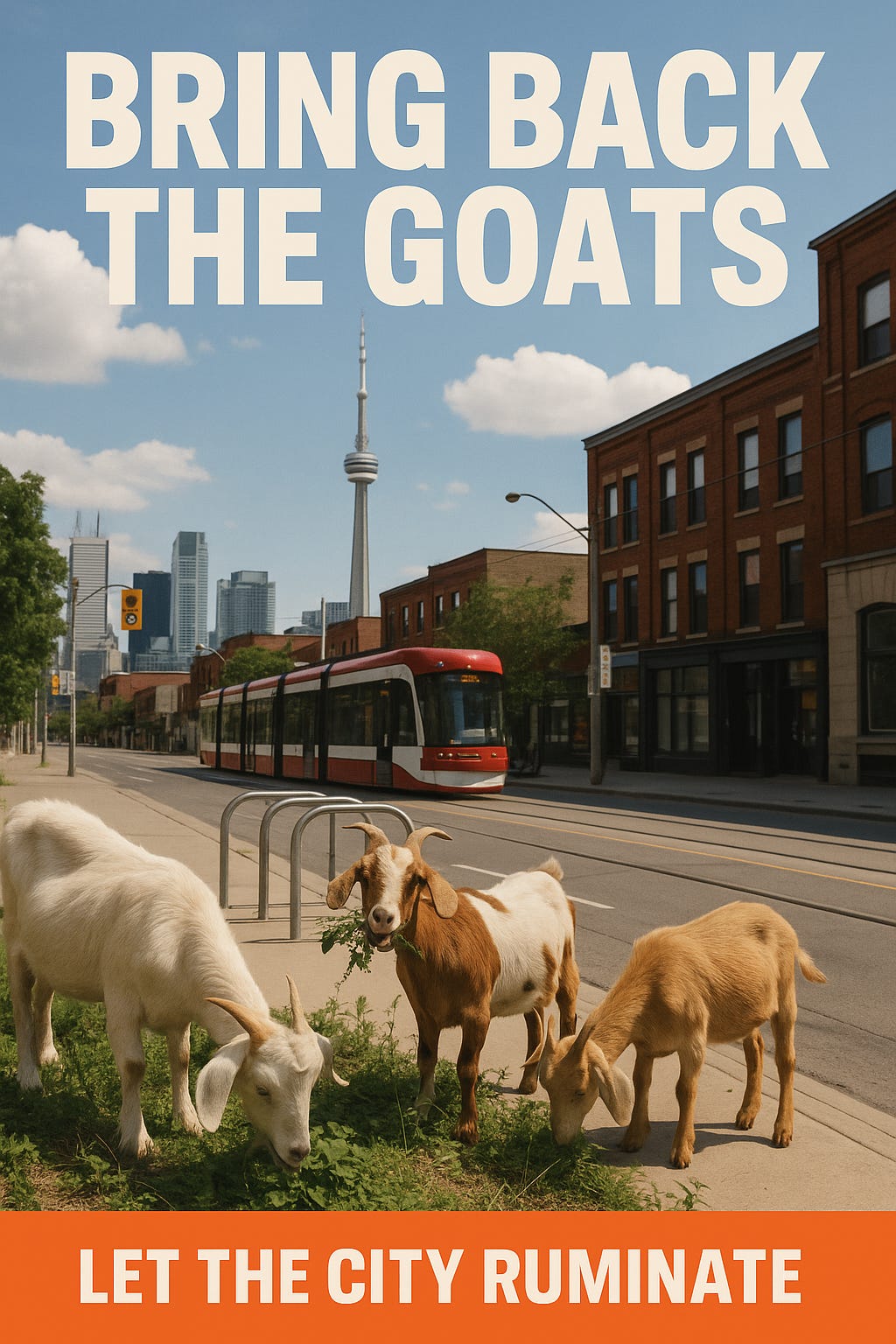
Bring Back the Goats.
Let the city ruminate.
Tiktok failed to load.Enable 3rd party cookies or use another browser