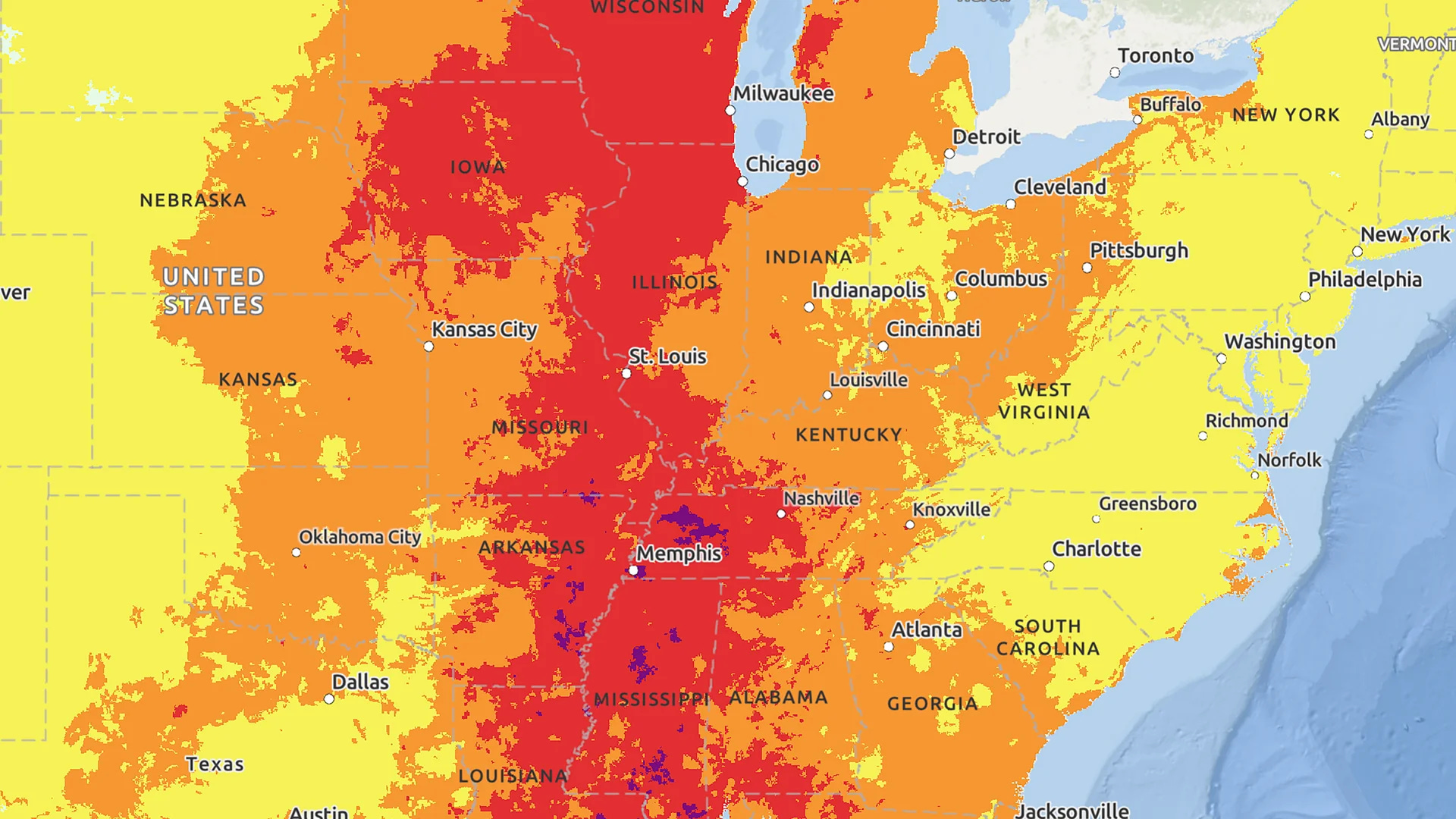
The storms are made of corn. This isn’t metaphor or myth. It’s meteorology.
Across the American Midwest and deep into Southern Canada, massive monocultures of corn release so much water vapor into the atmosphere that they are quite literally changing the weather. The process is known as evapotranspiration, and at peak growing season, an acre of corn can exhale over 4,000 gallons of water per day. When multiplied across tens of millions of acres, the result is a dense biome that produces its own heat, its own humidity, and in some cases, its own storms.
These aren’t anomalies. They’re engineered outcomes of an agricultural system designed to dominate land, maximize yield, and prioritize commodity markets over climate stability. The Corn Belt doesn’t just grow food or fuel—it manufactures weather. And the United States government, under the current regime, continues to deny the consequences of this manmade climate.
This is the face of anthropogenic weather: fields planted by policy, irrigated by fossil fuel, fertilized by nitrogen, and governed by subsidies. It is not simply that human activity influences the climate—it’s that our industrial systems are the climate, and corn is one of its most potent instruments.
The irony is that corn has been sold to the public as part of a climate solution. Ethanol, long pitched as a renewable alternative to gasoline, now accounts for nearly 40% of U.S. corn usage. Yet the ethanol economy is little more than a transfer mechanism for federal subsidies, a way to launder fossil fuel dependency through rural populism. Ethanol production relies on fossil-powered farming, fossil-fueled transportation, and fossil-based fertilizers. Its carbon footprint is buried beneath the myth of homegrown energy.
Corn has become a tool of both ecological disruption and political control. It props up a fantasy of self-reliance, concealing the dependency on federal subsidies, chemical inputs, and international trade. It creates landscapes that look natural but are anything but—single-species systems devoid of biodiversity, hostile to soil life, and entirely reliant on external inputs. This is agriculture in service of authoritarianism: centralized, extractive, brittle.
The current U.S. administration has doubled down on this model. In recent months, they’ve launched a campaign to dismantle what remains of climate policy. They’re seeking to repeal the EPA’s endangerment finding, which classifies carbon dioxide as a pollutant. They’ve suppressed the National Climate Assessment, threatened cuts to NOAA and NASA Earth science budgets, and celebrated state-level bans on climate education. In the face of record heat, wildfires, and storm damage, they are accelerating the destruction and calling it freedom.
The regime’s climate denial is not based on ignorance. It is rooted in domination. By denying that the climate is shaped by human systems, they preserve their ability to reshape it for corporate ends. To acknowledge corn storms is to acknowledge accountability—to admit that the rural landscapes they romanticize are engineered engines of atmospheric disruption.
Corn is the perfect authoritarian crop. It demands obedience—from land, from water, from farmers. It grows fast, under chemical control, and feeds industries far removed from the communities that grow it. It is the product of a command-and-control system, optimized for throughput, indifferent to consequence. It feeds cattle, fuels cars, and now powers the very storms that are reshaping the continent.
But it doesn’t have to. Corn is also a plant. A grass. A grain. In the hands of agroecologists, seed savers, and Indigenous farmers, corn can be a partner in regenerative practice. It can be grown polyculturally, rotated, adapted, shared. It can be liberated from its role as monoculture monarch and returned to the diverse systems that sustain life.
To do that, we must name it for what it is. Corn storms are not acts of God. They are acts of government, capital, and denial. And the only way to survive the weather we’re making is to reclaim the authority we’ve ceded—to rewrite the rules of the land, and who it serves.