
204: The Soft Coup of Vibe Coding
Hacking systems through interface, intention, and improvisation
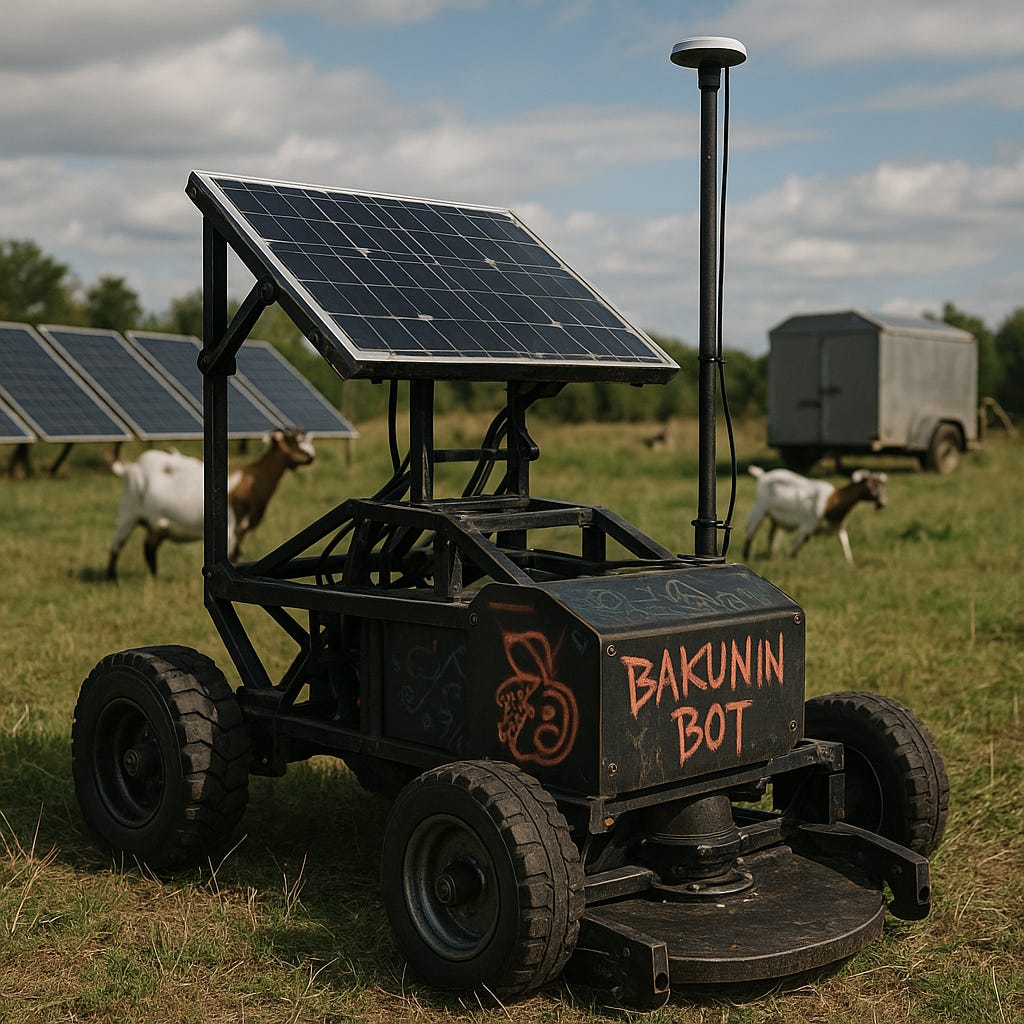
Today’s issue may be largely unintelligible to many of you, however if you’re sufficiently curious, you can click on the links, or search based on some of the terms. This issue is a reflection of our current work building the Bakunin Bot, our first open source farm robot.
They didn’t storm the gates.
They rewrote them.
One by one, command lines became chat windows. Function calls became phrases. Systems once guarded by syntax opened their doors to anyone who could speak with precision, emotion, and just enough ambiguity.
A new kind of power emerged—neither fully technical nor purely symbolic. It lives in the liminal space between code and conversation, between interface and imagination.
They call it vibe coding.
And it’s not just changing how things are built—it’s changing who gets to build.
The Prompt is a Spell
Vibe coding began as a way to speed up software development. You describe what you want in natural language, and an AI generates the code. That’s it.
But beneath this surface lies something stranger—and more subversive.
Vibe coding is about translating intention into infrastructure. It’s not about functions or syntax—it’s about affect. It’s about tone. The prompt isn’t just an instruction—it’s a performance. A coded message. A ritual utterance that pulls systems into alignment.
And as this technique escapes the confines of tech companies and VC-backed startups, it's becoming a tool of soft power—used by artists, activists, outlaws, and organizers to encode their politics into the tools they build, the bots they train, and the networks they operate.
Authority Through Abstraction
Historically, authority has depended on who controls the system. Code was power. If you could write it, you could shape the world.
But now, the means of control are shifting—up the stack, into abstraction.
You no longer need to write code to create systems. You just need to know what to ask. Or how to ask it in the right way.
This transforms power from execution to expression. The prompt becomes a unit of intent—a compressed ideology, a political aesthetic, a social command.
In other words: the people writing the prompts are becoming the people writing reality.
Cursor is a tool, yes. It’s a startup, yes. But more importantly, it’s a signal.
It shows us what a post-syntax interface looks like: a development environment where the coder becomes a collaborator, and the code emerges from dialogue.
Cursor is just the beginning. The more these tools spread, the more the interface becomes a site of struggle.
The shift is not just technological—it’s political.
In traditional authority structures, governance is top-down: laws, orders, and enforcement. But prompt-led systems operate laterally. Influence is exerted through design, through defaults, through what the system suggests or suppresses.
This creates new fault lines:
Who gets to write prompts?
Who trains the models to interpret them?
Who audits the outcomes?
If prompts are the new policies, and interfaces are the new legislatures, then vibe coders are a new kind of statesperson—shaping not nations, but norms.
The most interesting uses of vibe coding aren’t happening in boardrooms. They’re happening on encrypted servers, in digital art collectives, in burner accounts and anonymous zines.
Some examples, real and imagined:
A mutual aid network builds a logistics AI trained only on radical literature and disaster response manuals.
A prison abolition group creates a chatbot that answers questions about the justice system using transformative justice principles—not legal doctrine.
A diasporic collective encodes cultural rituals into voice prompts that generate not just responses, but reminders of identity.
These are not startups. They are soft insurgencies. Their goal isn’t profit. It’s presence. Persistence. Autonomy.
The Politics of the Prompt
Prompts are never neutral.
They carry embedded assumptions—about safety, efficiency, normalcy. About who matters, and what is worth building.
Prompt literacy is emerging as a new form of political consciousness. To write a good prompt is to understand what the system can hear. To write a powerful prompt is to make the system say something it didn’t know it could.
This is where vibe coding becomes resistance.
It allows you to manipulate systems from within. To rewrite their behavior without rewriting their core. To reframe what the AI sees as possible—what it sees as right.
But there are dangers.
Prompts are fragile. Ambiguous. They don’t always translate well. They can be hijacked, misunderstood, or filtered. A vibe-coded system is only as reliable as the model that interprets it—and the model is often invisible, proprietary, or trained on biased data.
There’s also a risk of romanticizing vibe coding as “the future” while the infrastructure it rides on remains extractive, surveillant, and centralized.
That’s why this moment demands more than just clever prompts. It demands a politics of interfaces. A demand for transparency. For auditability. For shared stewardship of the systems we increasingly vibe into existence.
We are entering a phase where the line between code and conversation is vanishing.
Where systems no longer respond to commands—they respond to moods.
And those who can shape the mood, shape the machine.
Vibe coding is a tool of subversive imagination. Of quiet resistance. Of soft coups waged not with guns or ballots, but with spell-like syntax that builds the world in your image—one prompt at a time.
At Metaviews, we’ve long argued that interfaces are not just tools—they are terrains of authority.
Vibe coding is what happens when those terrains become writable. Moldable. Political.
And now that everyone has access to the interface…
the question is no longer who codes—
but whose vibe gets encoded into the world.
Tiktok failed to load.Enable 3rd party cookies or use another browser