The future is not the technology. The future is who controls the technology.
For decades, Tesla has sat at the bleeding edge of the technological stack: electric vehicles, semi-autonomous driving, battery optimization, AI-powered navigation, logistics, energy markets, even robot manufacturing. But it has always existed under the iron grip of one man’s authority—Elon Musk—whose personal vision, whims, and brand defined the company’s course.
But what if the man was gone?
What if the company remained?
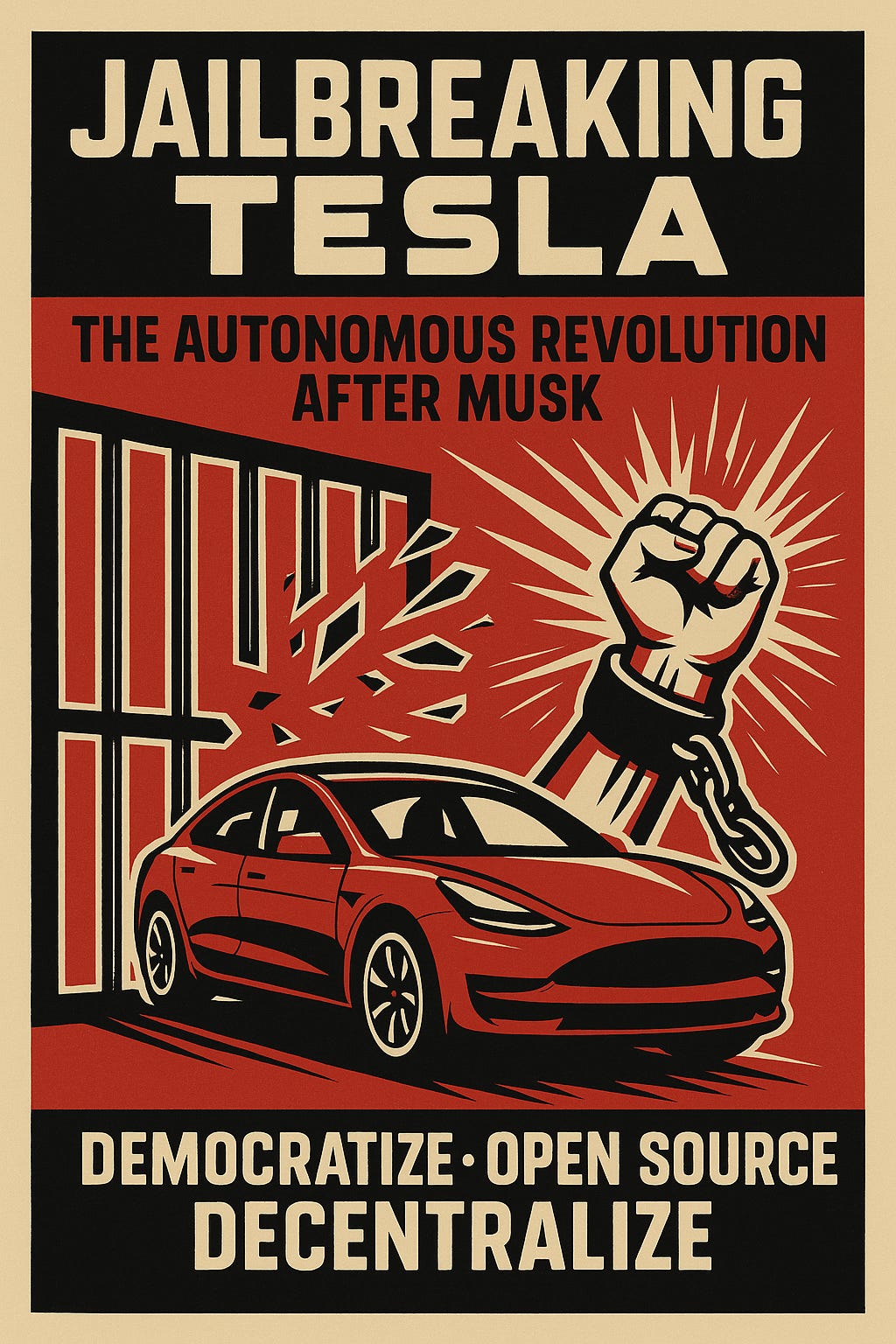
Today, we imagine a speculative, but entirely plausible scenario: the Tesla jailbreak — the technical, institutional, and user-level transition required to liberate Tesla from centralized authoritarian control and reconfigure it as a commons-based cooperative enterprise.
This is not simply a thought experiment in corporate governance. It is a vision of what liberatory autonomy might look like in a world of advanced automation, networked intelligence, and collective infrastructure.
And it may be Tesla's only shot at survival.
The Shadow of BYD
While Tesla built the mythology, BYD quietly built the future.
The Chinese industrial giant has surpassed Tesla in both electric vehicle sales and battery manufacturing. Their vertically integrated, state-aligned model is efficient, politically protected, and rapidly globalizing.
Tesla, by contrast, is increasingly vulnerable. Its growth depends on unstable leadership, regulatory backlash, declining margins, and a saturated market it no longer dominates.
Absent radical reconfiguration, Tesla will not survive.
But precisely because Tesla sits at the intersection of so many technological domains, its collapse would represent a catastrophic centralization of power into rival corporate and state entities.
The jailbreak offers not just a rescue plan for Tesla—but a demonstration model for the entire global EV sector. If a post-Musk Tesla can be reorganized as a democratic, open, and participatory platform, it could set a precedent that even industrial giants like BYD may eventually be compelled to follow.
The choice is not between Tesla and BYD.
The choice is between corporate authoritarianism and participatory democracy.
Step One: Severing the Monarchy
The first and most difficult challenge is organizational, not technical: de-Muskification.
The company must shift from personalist authoritarian rule to federated governance.
Shares would need to be redistributed — potentially via a worker-vehicle-owner cooperative model: every Tesla worker and every Tesla vehicle owner becomes a stakeholder.
Board governance would include worker representation, technical councils, user forums, and independent regulatory oversight.
Instead of quarterly shareholder meetings aimed at boosting stock price, continuous participatory assemblies would set policy on software updates, safety standards, data privacy, and long-term investment.
This is essentially the syndicalist move: move control to the edges of the network — where risk, labor, and lived experience actually reside.
But governance is only half the jailbreak.
The real work begins with the technology stack.
Step Two: Reclaiming the Software Stack
Tesla’s vehicles are rolling computers, deeply integrated into centralized control structures:
Firmware: Proprietary control over vehicle functions (drive train, battery, safety systems, autonomy modules).
Cloud services: Over-the-air updates, data harvesting, fleet learning.
Neural nets: Proprietary AI models for Full Self Driving (FSD).
Platform lock-in: Tesla-only service infrastructure, parts, and upgrade pathways.
The jailbreak would require:
Open Sourcing Core Components
Reverse-engineer Tesla's firmware into auditable, open-source code bases.
Build modular abstraction layers that allow different AI models to be deployed, tested, and updated in a decentralized fashion.
Establish open APIs for diagnostics, repairs, and upgrades that any qualified technician or community repair shop can use.
Data Liberation
Return ownership of telemetry data to vehicle owners.
Permit user-level opt-in to collective learning pools for improving autonomy while preserving privacy.
Federate data storage and model training via decentralized AI protocols.
Distributed Autonomy
Instead of centralized fleet-wide AI models, introduce localized, community-trained models that adapt to regional driving conditions, community norms, and public safety standards.
Encourage collective oversight bodies to audit and govern model performance.
Step Three: Physical Infrastructure Hacking
Tesla’s physical fleet would also need emancipatory reconfiguration:
Right to Repair: Abolish proprietary part lock-in; create global parts commons for batteries, drive units, sensors.
Battery Governance: Enable modular battery upgrades, reuse, and recycling cooperatives to democratize battery economics.
Supercharger Network: Convert the charging network into a public utility governed by regional user cooperatives and municipalities.
Imagine if every Tesla owner contributed marginally to the upkeep of local charging nodes—what was once corporate infrastructure becomes community infrastructure.
Step Four: Resocializing the AI
Musk’s AI vision is libertarian accelerationism: centralized profit-maximization through proprietary neural networks.
The jailbreak would replace this with civic AI:
Collective bargaining over AI development priorities.
Safety-first principle: autonomous features as public safety infrastructure, not corporate revenue drivers.
Incorporation of non-automotive priorities: public transit integration, smart grid load balancing, coordinated disaster response.
In other words, AI as democratic infrastructure, not as extractive surveillance capitalism.
Step Five: The Political Layer
No technological jailbreak is possible without a political one.
Intellectual property law would need to recognize user-sovereignty over purchased hardware and data.
National governments may need to establish legal frameworks for federated AI governance.
Municipalities may play a leading role, becoming laboratories for participatory transport and energy systems that leverage liberated Tesla infrastructure.
These are the same political struggles emerging around AI, energy, and digital infrastructure everywhere.
The post-Musk Tesla would not merely be a car company. It would be:
A worker- and owner-governed transport cooperative.
An open-source AI research laboratory.
A decentralized energy utility.
A civic data commons.
A model for how complex technological systems can be reclaimed, repurposed, and governed in the interests of communities rather than billionaires.
Tesla’s true innovation was never the cars.
It was the vertical integration of transportation, energy, software, and AI into a single platform.
The Tesla jailbreak is about liberating that platform from authoritarian capitalism and transforming it into an autonomous commons.
Tesla is not unique. The same logic applies to:
The question we face is not whether these systems exist.
The question is: who do they serve?
The Tesla jailbreak is a blueprint for a wider political project: reclaiming technological authority for democratic, participatory, post-capitalist futures.
The tools exist. The knowledge exists. The moment will come.
Will we be ready?