Our salon on Ontologies is scheduled for tomorrow at noon eastern. RSVP via metaviews at gmail.com…
It began with a smirk.
They called them trolls, keyboard warriors, agents of nothing.
The left laughed, confident that real power lived in institutions, in marches, in votes.
The internet was a carnival of noise — amusing, vulgar, beneath serious politics.
But while one side mocked, the other built.
In the shadows of forums and feeds, a new kind of power was taking shape.
Memes sharpened into weapons. Outrage became infrastructure.
Mockery, repetition, spectacle — not accidents, but tactics.
The old gatekeepers mistook it for chaos.
They didn’t see the network hardening beneath the surface.
They didn’t see authority migrating — from parliaments to platforms, from policy to perception.
By the time the spectacle swallowed the state, it was too late.
Mock the troll, lose the authority.
The Comfortable Lie of Slacktivism
For years, the left reassured itself with a simple narrative: online politics didn’t matter.
Liking, sharing, posting — these were indulgences. Slacktivism. Performative gestures that signaled commitment but achieved little. Real politics required bodies in the street, organizing in person, building unions and institutions.
This story comforted a generation of organizers who saw the digital sphere as secondary, even corrosive. The “serious” activists kept their distance, while the online world became a playground for humor, venting, and symbolic outrage.
But that dismissal was a fatal miscalculation. While the left scorned these arenas, others understood what was at stake.
The right saw not distractions but opportunities. They didn’t stumble into digital power — they engineered it.
They built online cultures that fused entertainment with ideology. Trolling wasn’t simply provocation — it was recruitment. Memes weren’t frivolous jokes — they were ideological transmission devices. Platforms like 4chan, Reddit, Facebook groups, YouTube, and later TikTok became incubators of networked power.
As Joan Donovan observes, these communities mastered media manipulation — exploiting the vulnerabilities of platforms, journalists, and publics to inject their narratives into the mainstream. They didn’t need to control legacy media outright. They only needed to distort the flows of attention.
And unlike many of their liberal counterparts, these movements treated the internet not as an adjunct to real life, but as real life itself.
The Migration of Authority
What the left failed to grasp was that authority was already migrating.
As Manuel Castells wrote in Networks of Outrage and Hope, “power resides in the networks.” The ability to generate shared narratives, mobilize collective emotions, and shape public perception increasingly took place online. The network became the terrain where legitimacy was forged — or undermined.
Antonio Gramsci’s concept of cultural hegemony helps clarify this shift. The right didn’t simply wait for political power to be handed to them; they cultivated a new common sense in digital spaces. They seeded language, frames, and symbols that gradually made previously extreme ideas feel ordinary.
While liberal institutions clung to the remnants of procedural authority, the right seized the cultural ground where legitimacy was being rewritten.
The Situationists long ago warned that modern life would be organized through spectacle — images and performances replacing substantive discourse.
Nowhere has this been more fully realized than in the digital political economy of the right. Figures like Trump and Bolsonaro don’t govern in the traditional sense; they perform governance as ongoing spectacle, feeding the attention economy with endless conflict, outrage, and loyal spectacle participants.
Memes aren’t just campaign materials; they are governance itself. The state as a content machine.
As Franco “Bifo” Berardi observes, this semiocapitalist dynamic dissolves the boundary between politics, entertainment, and affective manipulation. Authority is no longer conferred by policy competence or institutional legitimacy, but by one’s ability to command the flows of attention, emotion, and memeified conflict.
The Organizational Failure of the Left
The left's organizational instincts, forged in earlier eras, struggled to adapt to this new terrain.
Many of its efforts remained horizontal, decentralized, and allergic to the forms of centralized digital discipline that the right embraced. Movements like Occupy Wall Street, Black Lives Matter, and even parts of the Bernie Sanders campaign harnessed digital energy — but often lacked the sustained infrastructure to compete against right-wing media ecosystems that produced content, influencers, and narratives 24/7.
Zeynep Tufekci's work in Twitter and Tear Gas shows how digital platforms allow for rapid mobilization but struggle to support durable power. Tactical success does not guarantee strategic endurance.
The result? Fleeting viral moments for the left. Long-term narrative dominance for the right.
By dismissing online spaces as unserious, the left surrendered them. In doing so, they handed their adversaries the very machinery of cultural production.
The "keyboard warriors" that were once mocked became the shock troops of a new political order. They normalized extremism, undermined democratic legitimacy, and eroded the epistemic foundations of public life.
What was treated as symbolic play became actualized power.
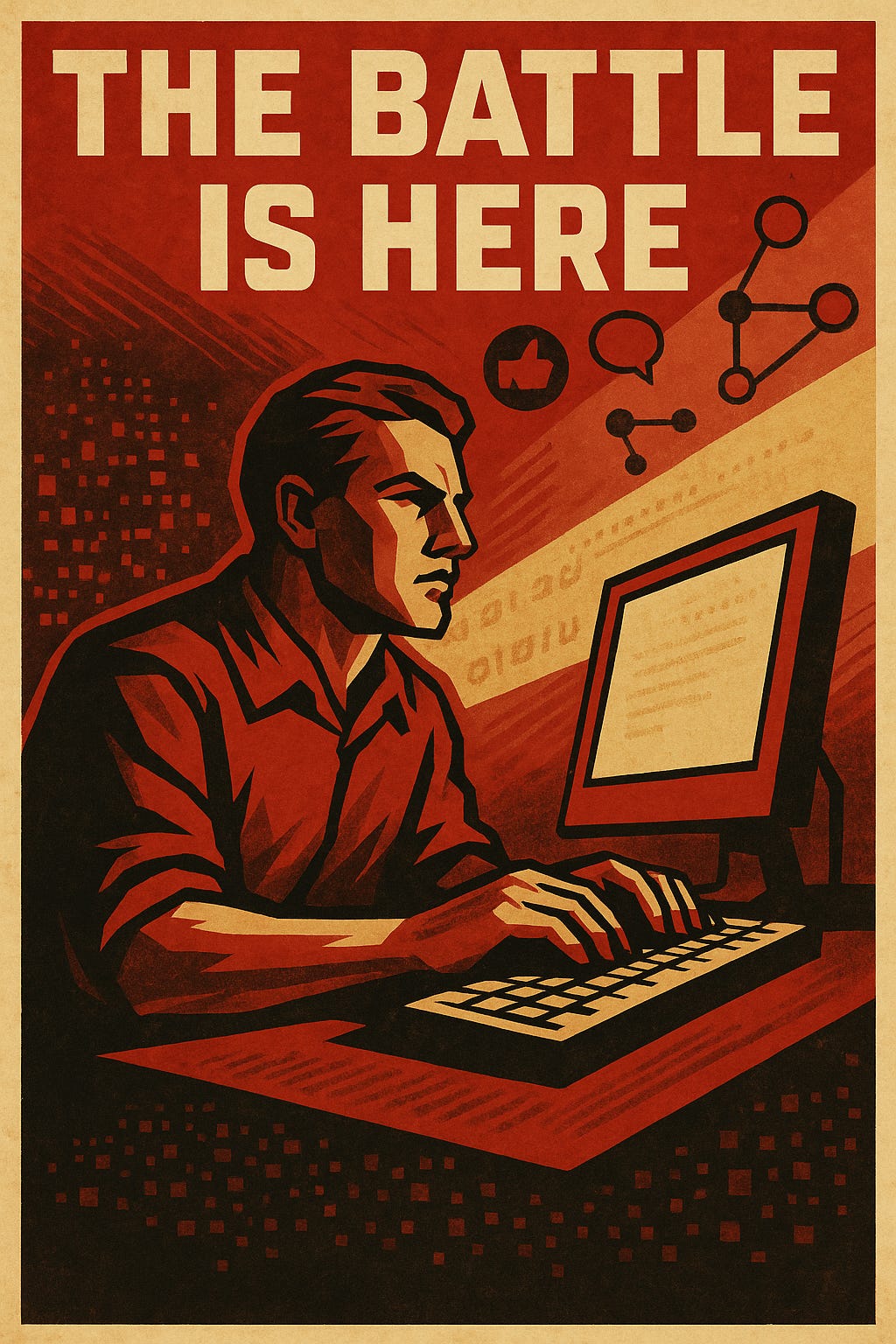
The authority that once resided in institutions has been absorbed into networks. The struggle for legitimacy now plays out in memes, feeds, and viral cycles as much as — if not more than — in parliaments and courts.
Authority today is hybrid: material, digital, emotional, and symbolic.
To rebuild democratic authority, we cannot afford to keep sneering at the arenas where power is now manufactured. The digital sphere is not a sideshow. It is the main stage.
If the left wishes to reclaim ground, it must treat networks as real sites of struggle — not simply for mobilization, but for narrative, culture, and ultimately, legitimacy itself.