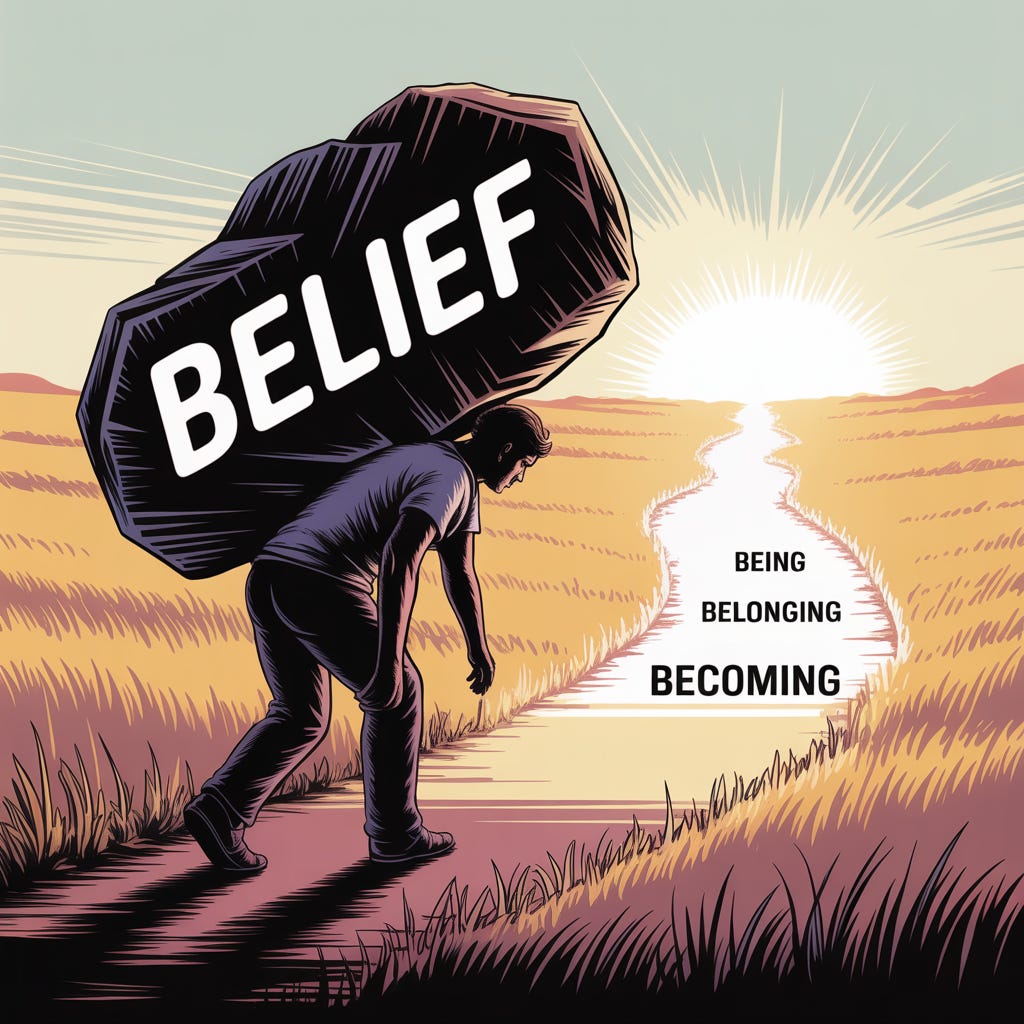
We live in an era drenched in belief.
Belief in ideologies.
Belief in conspiracies.
Belief in markets.
Belief in identities.
And while belief can give us strength, direction, and community, it can also imprison us. Belief, once rigid, once absolute, becomes a cage—a comforting one, perhaps, but a cage nonetheless.
For years, I’ve held close to what I call the three Bs of human fulfillment: Being, Belonging, and Becoming. These are the core needs that make us feel alive, connected, and open to growth.
Being is the freedom to inhabit your true self, however messy, complex, or unfinished that self might be.
Belonging is the human yearning to be part of something larger than yourself—a family, a movement, a place, a planet.
Becoming is the drive to grow, evolve, and transform beyond what you are today.
But lately, I’ve been reflecting on a fourth B that lurks like a double agent among the others: Belief.
Belief is tricky. It can animate the three Bs, give them scaffolding and meaning. Without belief, perhaps we wouldn’t have the courage to be who we are, or to belong, or to imagine new ways of becoming.
Yet belief is also what can freeze us in place.
It can distort being into a performance of what we think we should be.
It can transform belonging into a suffocating demand for conformity.
It can block becoming altogether by convincing us that we have already found the "truth" and no further change is necessary—or even allowed.
In this way, belief is both an accelerant and an anchor.
And if I look at our society today, I fear belief has become an anchor wrapped around our ankles, pulling us under the rising waters of change.
We see it in the political zealotry that divides people into camps of absolute rightness and wrongness.
We see it in cultural orthodoxies, both old and new, that punish anyone who dares deviate from the accepted script.
We see it in the way algorithms feed us a diet of certainty and tribalism, and punish curiosity and ambiguity.
Belief has become fanatical. And in its fanaticism, it denies the fluid, evolving, vulnerable nature of being, belonging, and becoming.
That’s why I now wonder if the three Bs might be our best antidote to belief itself.
What if instead of starting from belief—belief in a cause, an identity, a nation, a god—we started from being? From the messy, incomplete, authentic experience of who we are right now.
What if we pursued belonging not as a reward for loyalty to belief, but as a generous act of creating space for others, regardless of their beliefs?
What if we saw becoming as a perpetual, humbling journey—one that keeps us skeptical of fixed beliefs, and curious about what lies beyond them?
In this view, belief becomes not a foundation, but a companion—a guide, but never a master.
We can hold beliefs lightly, provisionally, as tools rather than commandments.
We can let our being, our belonging, and our becoming shape and refine our beliefs—not the other way around.
In a world suffocating under the weight of rigid belief systems, perhaps the radical act is to put the three Bs first. To live in a way that is more curious than certain, more relational than righteous, more open than orthodox.
Maybe that’s what freedom looks like today.