We’re now fully into the growing season and work on the farm not only demands my attention but pushes my body. Expect modestly erratic publishing and overuse of farm metaphors…
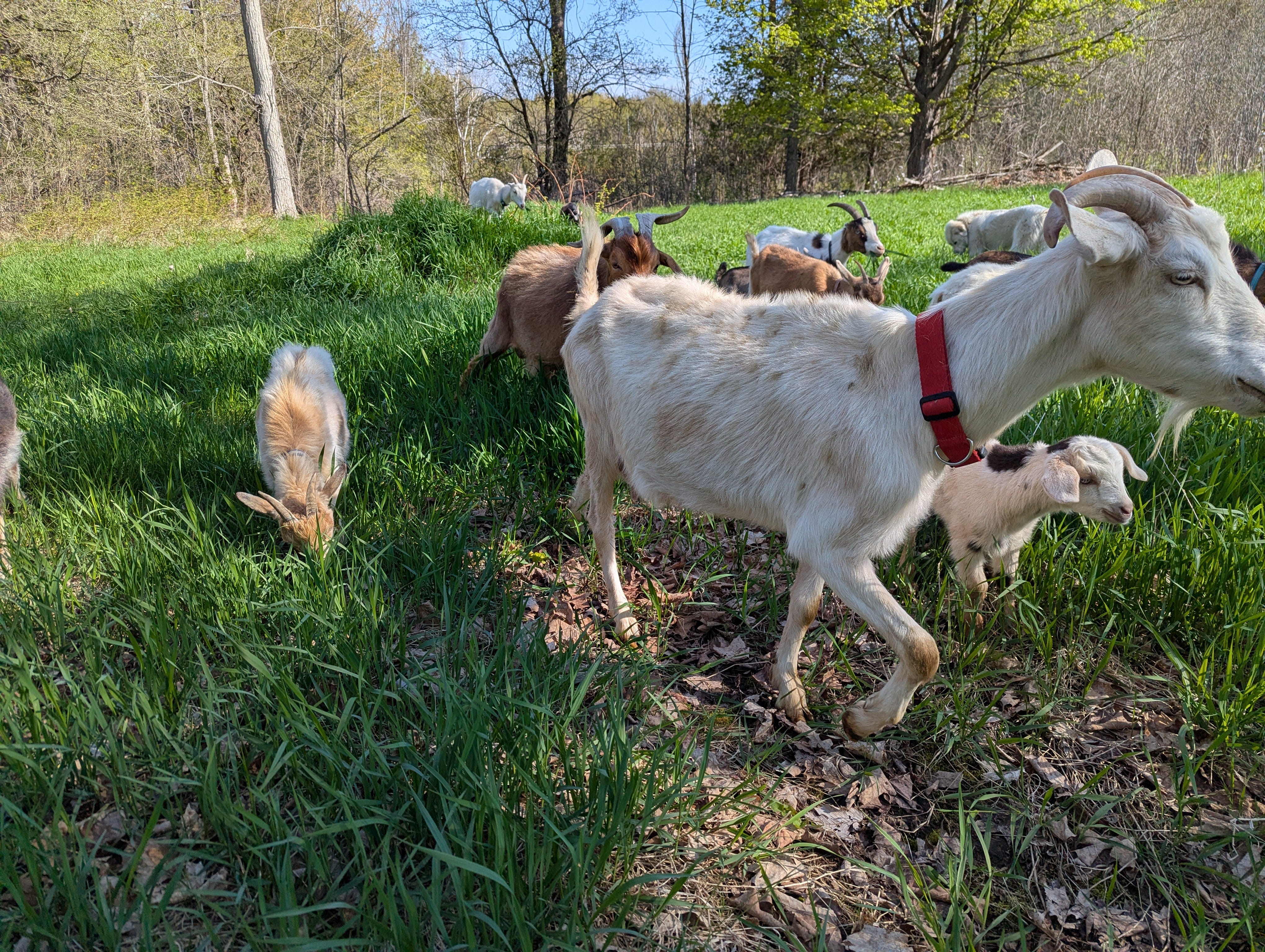
This morning, walking with my goats, I was struck by how easily they moved as one. No leader, no commands. Just subtle gestures, shared memory, and an unspoken contract of care. In their presence, I was reminded that herds are not just gatherings of animals—they are communities, webs of trust, and fragile systems of mutual survival.
As they grazed, played, and kept watch for threats, I couldn’t help but think about the places where herds—both animal and human—are being shattered. Gaza came to mind. So did the U.S.-Mexico border. So did the many places where the rule of law has ceased to protect, and instead, has become a weapon used to break solidarity, criminalize care, and destroy the very bonds that keep us human.
Herd Dynamics: A Law Older Than the State
Herds follow a law older than the state—older than civilization itself. It is the law of mutuality. Of rhythms learned over generations. Of care and vigilance, distributed without hierarchy.
Watching my goats this morning, I saw this law in action. Decisions are made by consensus, movements are negotiated in real time. No one goat dictates; they read each other, they trust each other, they stay alive together. This doesn’t mean submission of each individual goat, rather each goat gets a chance to lead, to explore, and yet have the herd to back them up.
This is not chaos. It is a sophisticated form of governance, one that Peter Kropotkin called mutual aid: a principle found not only among animals but as the basis of human survival long before the emergence of states, armies, and courts.
Gaza: The Siege of Solidarity Itself
In Gaza, what is under siege is not just territory, but the very capacity of Palestinians to act as a herd—to maintain networks of care, education, resistance, and life. Israel’s siege does not just kill bodies; it dismantles the social fabric. It seeks to scatter, to isolate, to destroy the capacity for collective agency.
And worse, it does so under the language of law. Israel claims legality in its violence. Yet the real assault is on the possibility of law itself. Gaza has become a laboratory where war crimes occur with impunity, undermining not only international law but the global belief that law can restrain power at all.
This is, as David Graeber might put it, the inversion of law into domination—a process by which violence becomes the law itself, and solidarity becomes criminalized.
The same patterns appear at the U.S.-Mexico border, where migration—a form of herd survival as old as time—is criminalized and pathologized. The state weaponizes law to fragment communities, separate families, and render migrants vulnerable and alone.
Anti-immigrant rhetoric depends on portraying migrants as invading herds—mindless, dangerous, alien. Yet migration is precisely the herd’s wisdom: move together when your land can no longer sustain you. Stay alive by moving as one.
The Rule of Law or the Law of the Herd?
What we see in Gaza and at the border is not the rule of law, but the law of rulers. As Silvia Federici argues, the modern state emerged by destroying the commons, breaking the bonds of mutual care, and criminalizing solidarity.
In this sense, Gaza is not an exception—it is an intensification of the war on the herd that defines capitalism itself. The herd is always suspect to those in power, because herds can move, resist, and survive without permission.
During the pandemic, we heard a lot about herd immunity. Yet we rarely talked about how herd immunity only works when everyone is protected. The same applies to rights, safety, and justice. Judith Butler reminds us that some lives are seen as grievable, while others are not. The law reflects this bias: some herds deserve protection; others deserve siege.
The lesson of the herd is that survival is never an individual affair. It is always collective, always relational, always fragile. What my goats know instinctively, our political systems have forgotten—or worse, deliberately abandoned.
From Gaza to the borderlands, we see how the rule of law has been hollowed out and weaponized against the very thing it once promised to protect: the community, the commons, the vulnerable. In this inversion, solidarity becomes an act of defiance. To offer care becomes subversive. To move together becomes criminal.
This is why the crisis in Gaza is not just a crisis for Palestinians—it is a crisis for international law itself. When the world watches, shrugs, and excuses war crimes, the very idea of law collapses. It becomes clear that under our current global order, law serves only those who already have power, and exists primarily to discipline, scatter, and dominate the herd.
Yet the herd persists. It moves in the shadows. It learns new paths. It builds new forms of law rooted not in state decrees but in mutual recognition and shared risk.
As Graeber argued, real law is born not from edicts, but from relationships. From the messy, negotiated, and radically democratic spaces where people figure out together how to live, how to care, how to fight.
If we are to resist the siege—not just of Gaza but of all who are made precarious by the war on solidarity—we must learn from the herd. We must restore mutual aid as the foundation of law. We must reclaim care as a political act. We must, as Federici urges, rebuild the commons wherever they have been destroyed.
The herd is not weak. It is not blind. It is how we survive. And it is how we will endure beyond the rulers, beyond the walls, beyond the siege.