
173: The Rise of Agentic Government?
How the Wreckage Becomes the Blueprint
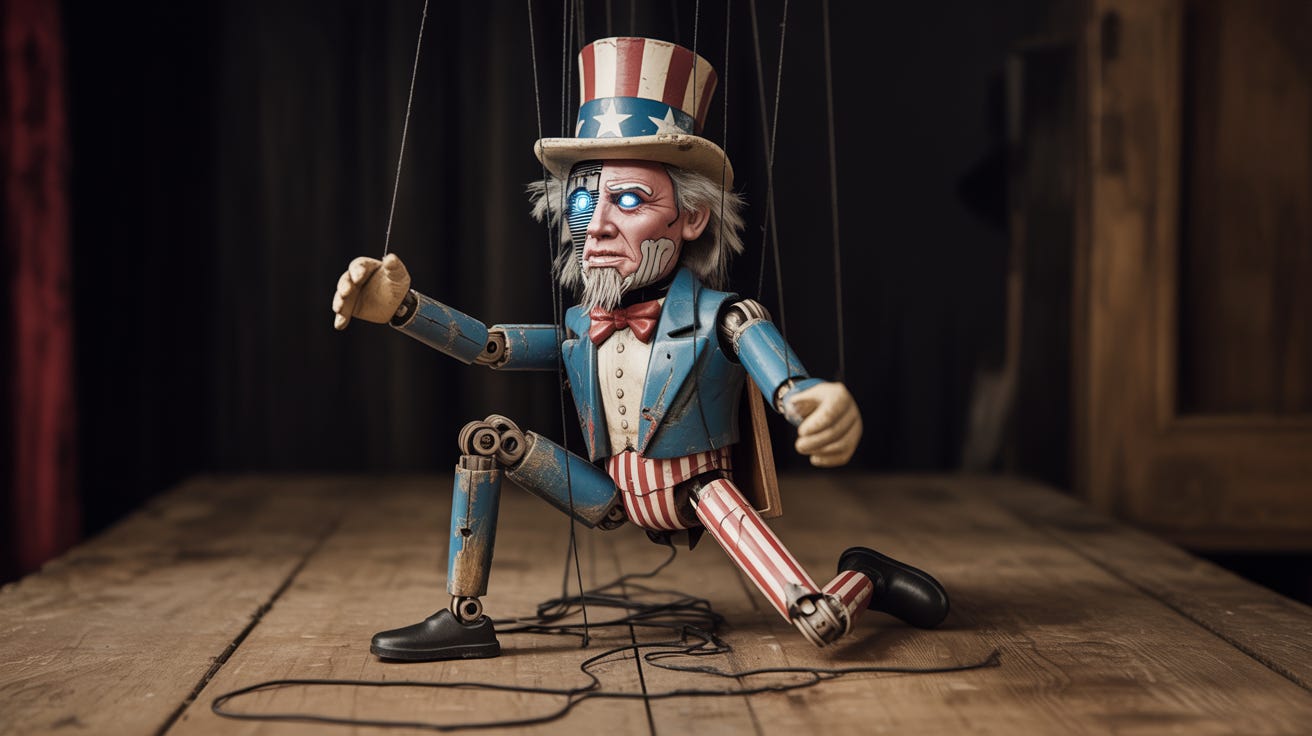
You don’t need tanks to topple a government anymore. Just enough chaos agents, a few well-placed algorithms, and the relentless erosion of trust will do the trick.
The Trump regime isn’t governing in any conventional sense. It is conducting agentic warfare: a decentralized, deniable assault on the legitimacy of the modern state. It doesn’t rely on statecraft. It relies on breakdown. Bureaucracies are hollowed out. Agencies sabotaged. Institutions turned against themselves. The goal isn’t to build something coherent. It’s to break things until people stop believing they can be fixed.
And in the rubble, something else is forming.
Agentic warfare isn’t conventional. It shows up in the form of online disinformation, rogue bureaucrats, private militias, AI-generated content, and bad-faith legal brinkmanship. It turns the comment section into a battlefield and the public record into a weapon.
In this new mode of conflict, sovereignty becomes porous. States bleed legitimacy. Authority becomes memetic, performative, and unstable. And just as war has changed, so too must governance.
The Vacuum That Follows
What happens when people stop believing in elections? In courts? In facts?
The result isn’t chaos forever. It’s vacuum. And vacuums don’t last. Something always rushes in to fill them.
Enter the tech elite.
While traditional governance implodes, Silicon Valley steps forward with a new blueprint: the network state. Built not on constitutions, but on code. Held together not by borders, but by metrics, subscriptions, and social contracts written by venture capitalists.
What Balaji Srinivasan calls the network state is a proto-form of something much larger: agentic government. A new regime where authority is distributed through platforms, guided by algorithms, and justified through data rather than democracy.
We’re already living in the transition. Trump destabilizes. Musk centralizes. Thiel funds alternatives. Each plays a role. Each exploits the vacuum in their own way. And all of it operates under the guise of disruption and innovation.
Meanwhile, new forms of governance begin to take shape:
Platform-based dispute resolution
Blockchain-anchored citizenship
Tokenized loyalty in place of civic trust
Algorithmic moderation as law enforcement
It’s not that the state disappears. It’s that it becomes one actor among many. No longer the sole authority, but a deprecated API in a vast, shifting network of power.
Forking Futures
Agentic government is not inherently dystopian. It could empower communities, localize control, and democratize decision-making. But right now, it’s being prototyped by those who benefit most from unaccountable control.
The network state isn’t just a tech experiment. It’s a political project. And like all political projects, it’s about who gets to rule and why.
The Trump regime is clearing the way. The tech elite is building the replacement. And the rest of us are left to decide whether to resist, participate, or fork our own future.
The future of authority is no longer national. It’s networked. It’s ambient. It’s agentic.
The question isn’t whether we’ll be governed. It’s whether we’ll have a say in what governance becomes.
Tiktok failed to load.Enable 3rd party cookies or use another browser