
172: The Internet Cannot Be Ignored
Why ignoring digital discourse is ceding the future to chaos.
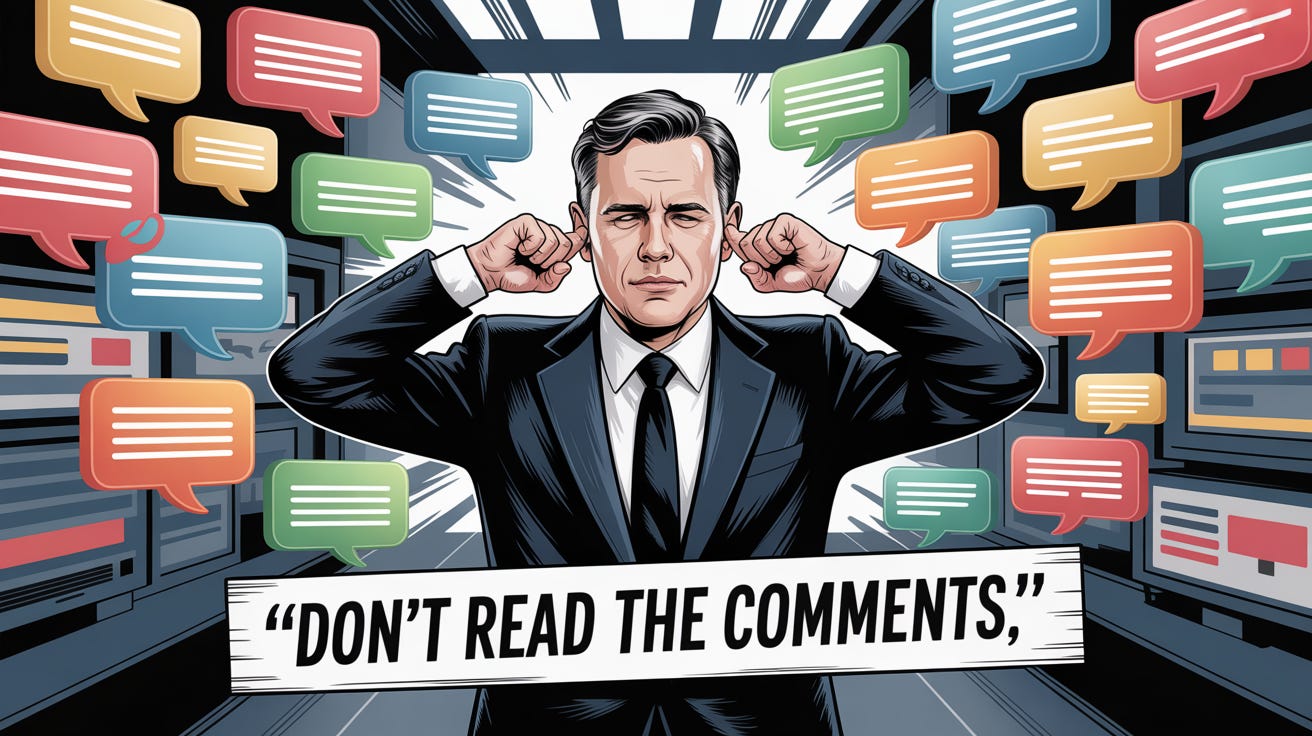
"Don’t read the comments."
It sounds like harmless advice. But it has become a coping mechanism for the powerful—a way to tune out criticism, dismiss dissent, and sidestep accountability. The result? A political establishment that is deaf to the digital public, blind to emerging movements, and increasingly irrelevant in a world shaped by memes, livestreams, and the rise of online communities.
The internet is not just a tool or a trend. It is the dominant public space of our time. It's where people debate, organize, form identities, and build movements. It has changed how we communicate and, in turn, how power operates. But rather than meet this shift with curiosity or adaptation, most institutions have recoiled. Governments, media, and elite organizations have treated the internet like a distraction—something best managed by junior staff or PR consultants. They chose not to engage. And in doing so, they created a dangerous vacuum.
Sociologist and technology researcher danah boyd has spent decades studying what she calls "networked publics": the online spaces where people, especially youth, develop their voice and navigate power. Her work has highlighted how digital platforms have become primary arenas for identity formation, political expression, and social learning.
Nowhere is this clearer than in the radicalization of young men. Online platforms like YouTube, Discord, and Reddit have become recruitment grounds for far-right ideologies. These platforms didn’t just transmit content—they nurtured community. The far-right offered not only answers but a sense of belonging. In these spaces, grievance became identity, and algorithms amplified extremism in pursuit of engagement.
Meanwhile, institutions kept their distance, clinging to outdated communication models. Harold Innis, a foundational media theorist, argued that empires rise and fall based on how they manage communication. He distinguished between time-biased media, which preserve tradition, and space-biased media, which expand control. The internet collapses both time and space. It demands flexibility, transparency, and dialogue. And yet our institutions continue to govern as if they were still on television.
A Culture of Dismissal
The phrase "don’t read the comments" is now a mantra of elite culture. It's often meant as self-care, but it doubles as a tactic of disengagement. It implies that online discourse is toxic by default, and that those who participate are unworthy of attention.
This dismissal has political consequences. When the public expresses anger, fear, or criticism online, it should be an invitation to listen. Instead, institutions roll their eyes. They frame dissent as irrational, conspiratorial, or mentally unstable. This pathologizes opposition and deepens mistrust. And it leaves digital communities vulnerable to those who are willing to take them seriously—even if their intentions are harmful.
danah boyd warned us that young people were growing up online, in public, and without support from the institutions meant to guide them. She observed how they used social media to form relationships, explore identity, and find meaning. These were not trivial observations. They were early signs that power was shifting.
She also raised concerns about surveillance and control. Platforms were not neutral; they shaped behavior, often in ways that benefited advertisers and corporations over users. boyd urged us to recognize how these dynamics influenced democracy and public discourse. Her calls went largely unanswered by the establishment.
Instead of building better tools or public infrastructure for digital life, governments and institutions ignored the problem. They left young people to navigate the internet alone, and left digital culture to be defined by commercial and ideological forces.
When institutions step back, others step in. The far right has excelled at digital engagement. They didn’t treat the internet as a threat—they treated it as home turf. They built narratives, forged communities, and offered clear identities in a confusing world.
A young man searching YouTube for advice on fitness or dating might be drawn into a rabbit hole of escalating content. He starts with motivational videos, then finds material on gender roles, then conspiracy theories, then white nationalism. The path isn’t always obvious. It doesn’t feel like indoctrination. It feels like someone finally gets it.
And it works because it speaks to real feelings: alienation, resentment, uncertainty. These are not emotions unique to extremists. They are part of being young in a world where trust in institutions is collapsing. The far right simply offers a story—one that is dangerous and false, but emotionally resonant.
Harold Innis argued that communication technologies shape the structure of civilization. Societies that embrace new media forms gain an advantage. Those that resist them fall behind. When the printing press spread, so did the Reformation. When broadcast radio took hold, so did mass politics.
The internet is our new medium, and it is rewriting authority. It is fast, participatory, decentralized. It rewards transparency and punishes delay. Yet most governments still operate like broadcasters. They issue press releases. They hold stage-managed briefings. They avoid direct conversation with the public.
This mismatch between medium and method is fatal. A governing system that cannot adapt to its environment will eventually lose control of the narrative—and with it, the public.
Toward a Politics That Reads the Comments
We don’t have to accept this trajectory. The internet doesn’t belong to extremists or tech billionaires. It belongs to all of us. And it remains full of democratic potential—if we choose to engage.
Reading the comments is not about agreeing with everything. It’s about understanding what’s out there. It’s about listening, especially when it's uncomfortable. Real democracy requires contact. It requires care. And in the digital age, that means meeting people where they are: online.
We can rebuild authority through engagement, humility, and shared experience. But first, we have to stop pretending the internet doesn’t matter.
Because the longer we ignore it, the more power we give to those who don’t.
Tiktok failed to load.Enable 3rd party cookies or use another browser