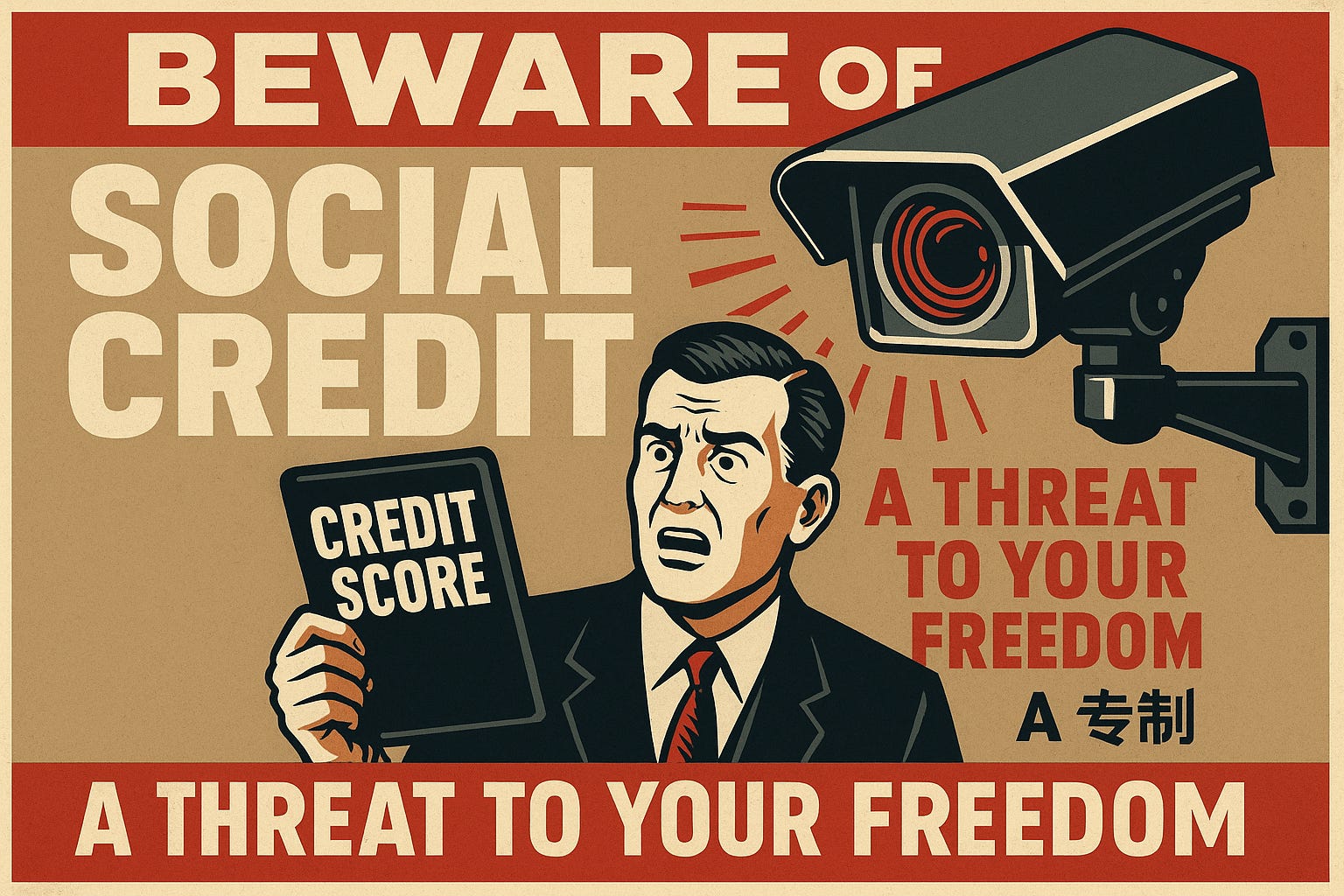
If you've heard the chilling tale of China's "social credit system," you might imagine a vast, omnipotent machine judging every citizen's worth based on loyalty, behavior, and obedience. It's a techno-dystopia made for Netflix.
The truth? The "Chinese social credit system" is mostly a myth — a patchwork of bureaucratic databases and regulatory blacklists, far less centralized and invasive than Western headlines suggest.
Meanwhile, the Western world already lives under a much harsher, more consequential credit regime — the private credit score industry — which ruins lives, locks people out of housing, education, and healthcare, and entrenches economic inequality.
We are fighting the wrong monsters.
Dispelling the Myths of China's Social Credit System
Western narratives often frame China's social credit initiatives as an all-seeing digital panopticon. In reality, there is no single "social credit score." Instead, there are thousands of local pilot programs and sector-specific efforts, most of which target companies rather than individuals. These fragmented systems primarily enforce compliance with existing laws, such as cracking down on businesses that evade taxes or individuals who refuse to pay court-ordered debts.
Rather than operating through a seamless AI-powered surveillance network, China's social credit initiatives are characterized by bureaucratic fragmentation, overlapping regulations, and inconsistent enforcement. Mass surveillance in China, especially the brutal repression of Uyghurs and other minorities, is indeed real and horrifying, but it operates through entirely different systems. Blurring these realities together not only misinforms but obscures the true mechanisms of authoritarianism.
This is not to excuse China's governance practices. It is to correct a narrative that feeds Western fears while distorting the nature of the threat.
The Hidden Brutality of North American Credit Scores
While fixating on Chinese fantasies, Western societies have normalized their own brutal systems of economic judgment. Credit scores in North America, managed by private corporations like Equifax, TransUnion, and Experian, operate without transparency or meaningful accountability. Errors are common and difficult to challenge, leaving individuals powerless against opaque algorithms that determine their access to essential services.
Unlike the social credit experiments in China, North American credit scores carry profound and punitive consequences. A single missed payment can tarnish a person's record for years, impacting their ability to secure housing, employment, insurance, or even basic utilities. These systems disproportionately harm marginalized communities, entrench racial and economic inequalities, and extend systemic exclusions under the guise of objective financial assessment.
Adding insult to injury, credit histories are commodified without genuine consent, turning the intimate details of people's financial lives into marketable assets. The moral weight assigned to "creditworthiness" becomes a proxy for who is deemed deserving of dignity, stability, and opportunity.
The Trend Toward Algorithmic Governance
Both China's experiments and North America's entrenched systems reveal a deeper, more alarming pattern: the rise of algorithmic governance. In China, this trend manifests through state-driven surveillance projects that monitor loyalty and political compliance. In the West, it appears through the invisible hand of corporate data monopolies that quietly assess, rank, and control access to society's resources.
In both cases, human judgment is displaced by automated reputational metrics. Complex lives are reduced to simplistic scores. Authority, whether public or private, becomes increasingly mediated by unseen and unaccountable systems.
The real threat is not the foreign caricature. It is the algorithmic infrastructure already embedded in daily life.
We should be vigilant against the dangers of state surveillance and repression, wherever they occur. But we must also resist the temptation to project our fears onto foreign others while ignoring the oppressive systems we have built at home.
The myth of China's "social credit dystopia" serves powerful political purposes in the West. It distracts from the reality that we, too, live under regimes of digital punishment and algorithmic control.
The future of authority will not be shaped by distant, imagined dystopias. It will be determined by whether we confront and dismantle the systems of judgment and exclusion that already govern our lives.