Polling is a performance. Elections are theater. Governance is sustained by carefully curated delusions. Is this just politics—or have we entered something else entirely?
We know politicians lie. We expect it. We even rationalize it: "They have to do it to win." But what happens when the lie isn't just a tactic, but the whole terrain? What if political life today is defined not by how well someone governs, but how well they pretend?
This is the age of performative politics, where the most dangerous lies are not necessarily the ones politicians tell us—but the ones we tell ourselves.
The Polling Paradox
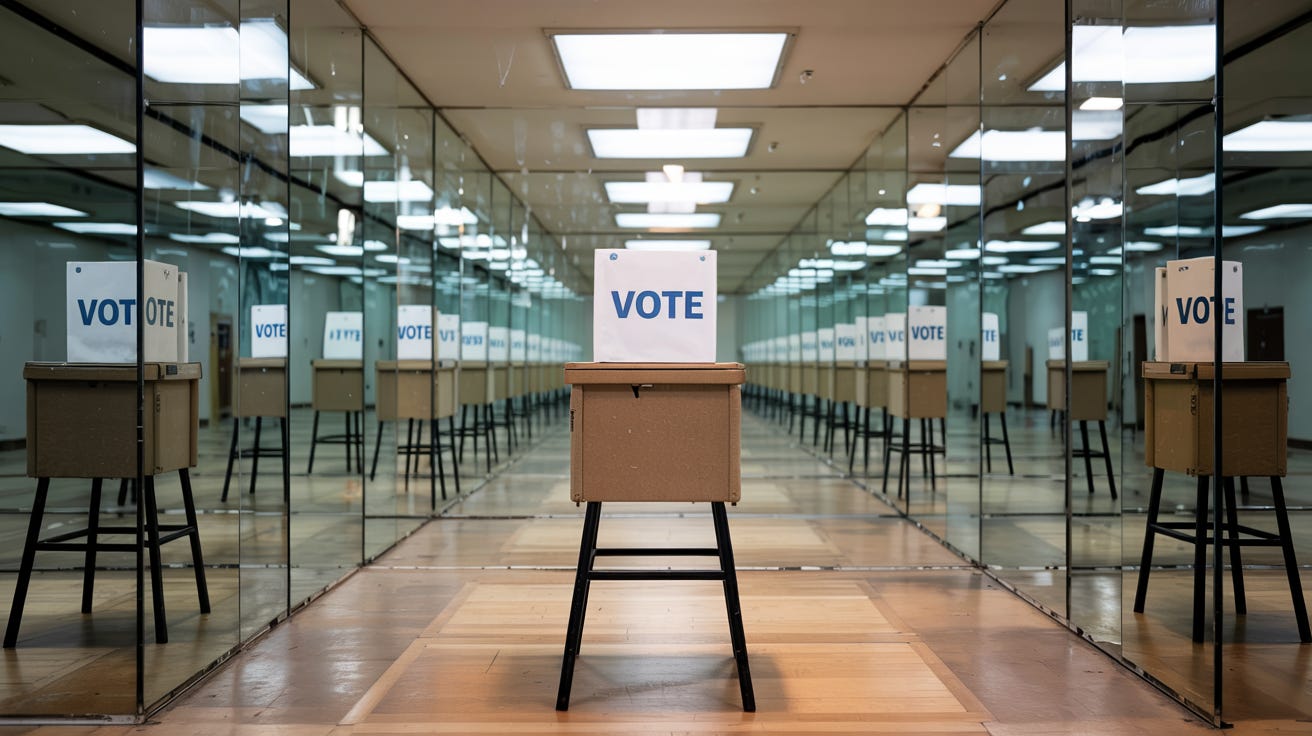
People lie to pollsters. Sometimes consciously, sometimes not. Social desirability bias pushes respondents to say what they think they should say rather than what they really believe. No one wants to admit they support authoritarianism. Or oppose immigration. Or question vaccines. But once they get into a voting booth—or a private group chat—those truths re-emerge.
This isn't just a problem for pollsters. It undermines the whole feedback mechanism of democracy. When the signals we send are distorted, the systems meant to respond to us become unresponsive. And when that happens, voters lose trust—and tune out.
Campaigns are now carefully scripted narratives—fanfiction about the society we want to live in. The candidate is cast as the hero. Their opponents are the villains. The policy proposals are plot devices. Victory is the happily-ever-after.
This isn’t new. But the degree to which spectacle has overtaken substance is accelerating. We are no longer electing policymakers, but influencers. The job interview isn’t about what they’ll do—it’s about whether they can keep us entertained.
And the truth? It gets in the way of a good story.
It’s not just that politicians lie to us. Many lie to themselves. They have to. Governing is impossible without a degree of self-delusion. To endure endless scrutiny, betrayal, compromise—to look in the mirror and still see a leader—requires myth-making.
They tell themselves the people love them. That the system works. That they're doing what must be done. This is how "lesser evil" logic justifies catastrophic decisions. It’s how war gets sold as peace. How surveillance becomes safety.
In the absence of accountability, self-deception becomes a survival skill.
But it’s not just them. It’s us too.
We adopt political lies to simplify an unbearable reality. That our lives are shaped by forces beyond our control. That the systems we rely on are crumbling. That no one is coming to save us.
So we believe in policies that can’t be passed. Movements that won’t win. Leaders who won’t lead. We accept the illusion because the alternative is despair.
Lies become coping mechanisms. Emotional infrastructure. They help us make sense of senselessness.
Is Politics Still Possible?
Maybe the bigger question isn’t how we restore truth to politics, but whether politics—as we know it—is salvageable. Has the category itself been corroded beyond repair?
Once upon a time, politics was the art of the possible. Now it's the management of disbelief. The gap between performance and reality has become so wide that it swallows everything: trust, legitimacy, accountability.
We live in a hypernormalized state, where everyone knows the system is built on lies, but everyone pretends it isn’t. Because pretending is easier. Safer. Less risky than facing the void.
Yet somewhere in this mess is also an opportunity: to imagine politics anew. Not as spectacle. Not as management. But as mutual recognition. As collective truth-telling.
A politics grounded in mutual recognition would not seek to simplify or soothe, but to understand and to witness. It would prioritize shared realities over spin, and interdependence over performance. It would require vulnerability—not as weakness, but as strength. The courage to say: this is what I know, this is what I fear, this is what I hope. And to hear the same from others.
Axel Honneth has argued that recognition is not just emotional or interpersonal, but political and structural—a prerequisite for justice and self-realization. Without it, social life devolves into pathology. In this light, mutual recognition is not a lofty ideal, but a necessity for reclaiming legitimacy.
David Graeber, too, reminded us that power doesn’t have to be vertical. His vision of mutual aid and horizontal coordination gives us models for politics that don’t rely on performance or deception, but on trust and voluntary cooperation.
And bell hooks, ever the theorist of love as a political force, taught us that recognition can be radical when it is rooted in care. That the refusal to dominate, the choice to see and be seen, is not just ethical—it is revolutionary.
Such a politics may be unfamiliar, but it is not unreachable. It begins not with power, but with presence. Not with persuasion, but with listening. It begins with the refusal to lie—to others, and to ourselves.