They do not want to govern. They want to own.
They do not want a society. They want a marketplace.
They do not want freedom. They want impunity.
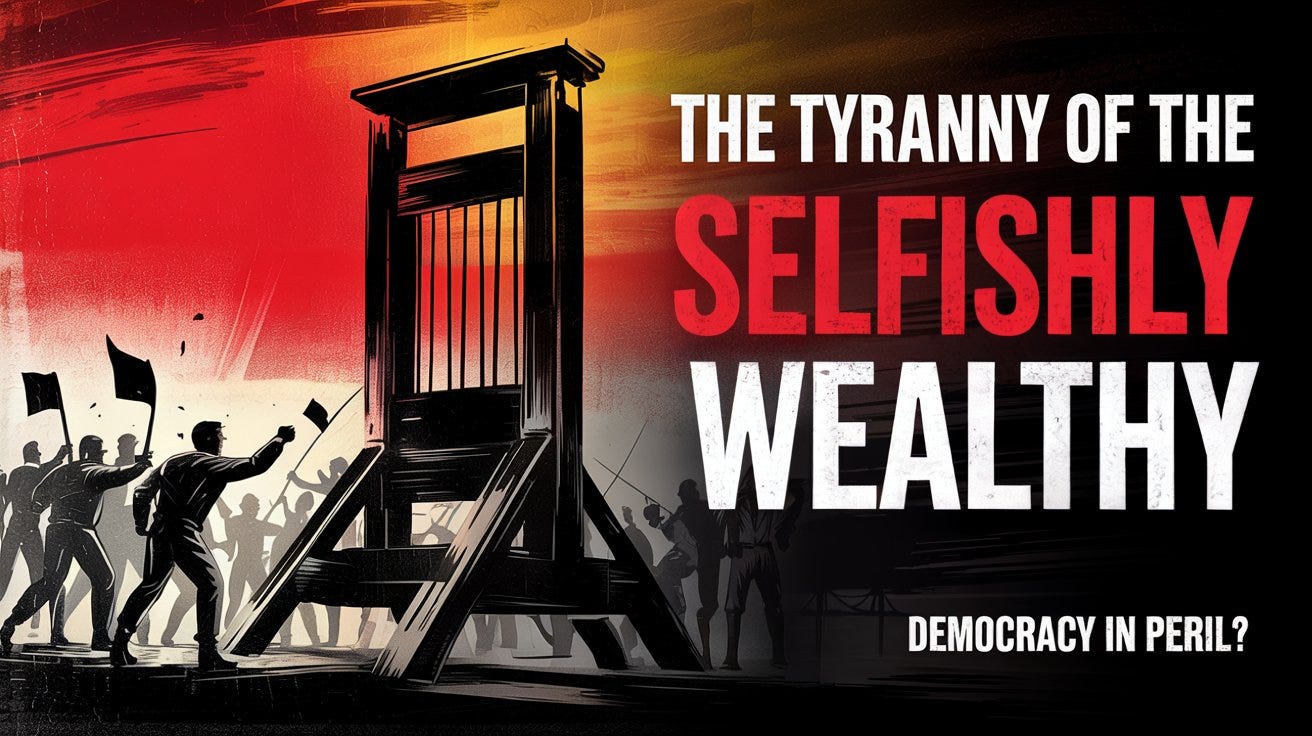
At the heart of today’s global disorder—whether it’s Trump’s buffoonish authoritarianism, Canada's slow descent into American-style inequality, or the planetary failure to address climate collapse—is a class of individuals whose wealth has become a weapon. Not just against poverty or taxation, but against democracy itself.
This is the tyranny of the selfishly wealthy.
They are not content to merely accumulate. They seek to annihilate—public institutions, social programs, and any form of regulation or taxation that dares to check their power. What was once a social contract has been replaced by a corporate charter, where the state becomes a service provider to oligarchs and a disciplinary apparatus for everyone else.
The Assault on Democratic Infrastructure
Democracy, at its core, is the capacity of people to organize the rules of their shared lives. That means taxation. That means regulation. That means a public sector with real power. These are not bureaucratic details—they are the architecture of collective freedom.
But to the billionaire class, these are threats. Taxes redistribute. Regulations restrain. Democratic governments, when they function, are capable of setting limits on greed and creating opportunities for others. So the strategy has been simple: hollow out the state, buy off the politicians, and convince the public that freedom means living at the mercy of private interests.
We see this clearly in the Trump regime. Behind the chaos lies a cold logic: dismantle the last vestiges of a functional government, and sell what’s left to the highest bidder. Deregulation is framed as liberation, even as it poisons air, water, and labor rights. Tax cuts are sold as growth, while infrastructure crumbles and public education is gutted.
This isn’t just mismanagement. It’s ideological warfare—one waged by the ultra-rich against the idea that society should be fair.
The Cult of Wealth and the Death of Shame
Once, wealth came with expectations. Responsibility. Noblesse oblige. That façade has been obliterated. In its place stands a new aristocracy of shamelessness—Musk, Thiel, Bezos, and their ilk—who openly mock democracy while building bunkers, launching vanity rockets, and fantasizing about AI-ruled techno-utopias for the chosen few.
The new wealth class has no desire to fix the world. They want to escape it. Or better yet, rule it with the precision and unaccountability of a software update. They see politics not as a public concern, but as a legacy system to be disrupted or deleted.
But we must insist: wealth is not wisdom. Capital is not character. And no amount of market efficiency can replace the moral and civic obligations of a society governed by the people.
Reclaiming the Commons: Resistance and Imagination
If the selfishly wealthy seek to dismantle our collective power, the antidote is to double down on it. This means reclaiming taxation as a moral act. Celebrating regulation as the defense of the vulnerable. And insisting that democracy is not a marketplace of interests, but a forum for justice.
Movements around the world are already pointing the way. From union strikes to mutual aid networks, from open-source software to the global climate justice movement—people are building alternatives that reject extraction and celebrate interdependence.
But we need more. We need vision. We need courage. We need to stop believing that rich people are smarter, or that they are owed control because they "create value." We need to remember that the most valuable things in life—clean water, public care, creative expression, belonging—are not created by markets but by people working together.
The Future is Not for Sale
We will not tax the rich because we envy them.
We will tax the rich because they broke the system that feeds us all.
And we will regulate capital not to punish success, but to protect survival.
The tyranny of the selfishly wealthy is not inevitable. But ending it requires clarity about what democracy actually demands: not just voting, but governing. Not just voices, but power. Not just outrage, but infrastructure.
This is the fight. And it’s already begun.