
157: Extreme Discombobulation
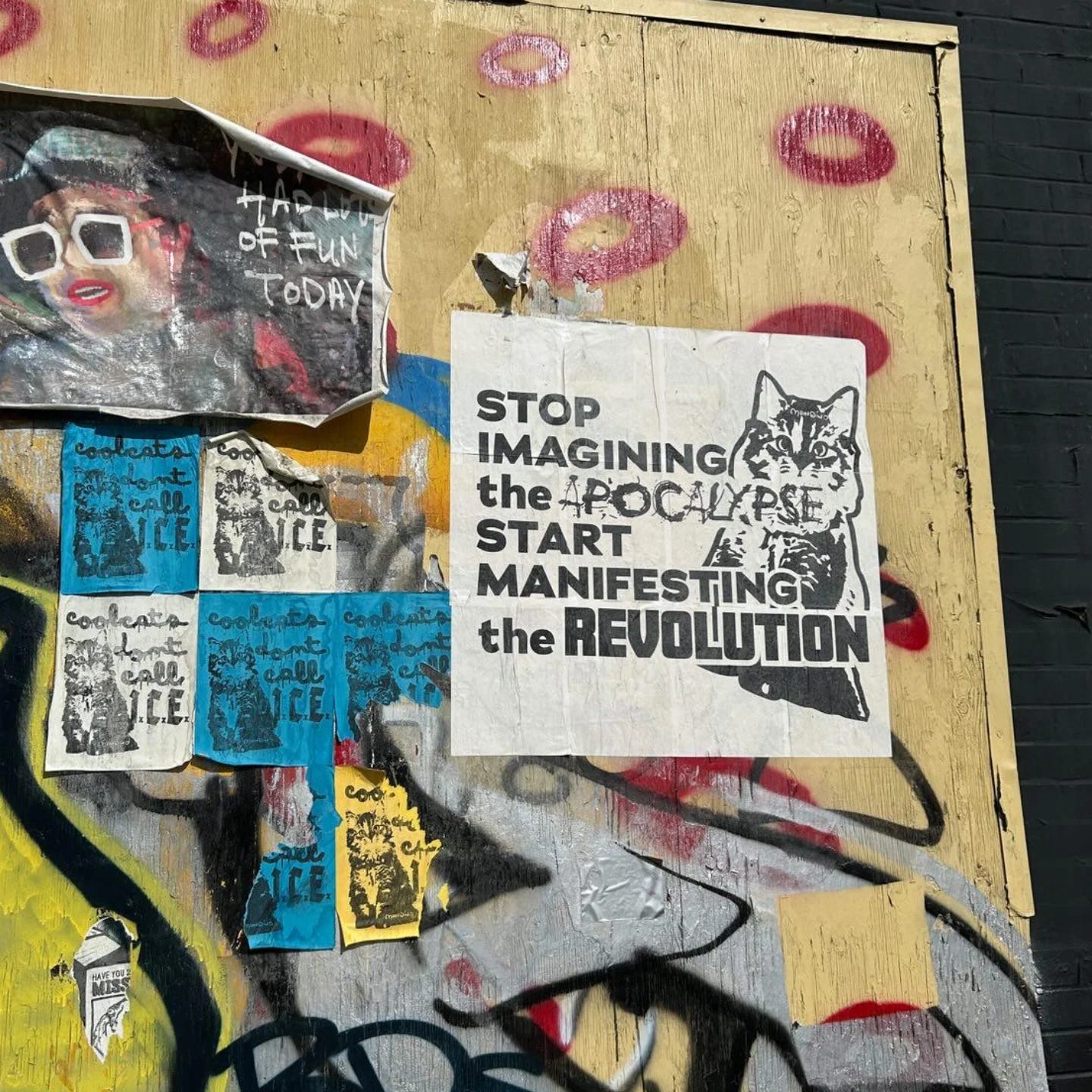
Stop Imagining the Apocalypse and Start Manifesting the Revolution
You can feel it in your bones.
The dissonance.
The hum of contradiction vibrating through headlines, markets, courtrooms, and campaign stops.
Reality is twisting in real time—and the result is extreme discombobulation.
There’s a particular madness to this moment in political economy. One where the old scripts no longer make sense, but the new ones haven’t been written—or worse, are being improvised by people who don’t seem to care whether the audience lives or dies.
Last week, Wall Street cratered. The Dow dropped over 3,000 points in a matter of hours. Economists stumbled onto cable news trying to spin it as cyclical volatility. But anyone paying attention knew the trigger: President Trump’s surprise expansion of tariffs—this time targeting not just China, but Germany, Brazil, Mexico and Canada. All of this allegedly to “discipline global capital.” But what discipline looks like stocks plummeting, pension funds shrinking, and the Fed issuing late-night communiqués no one believes anymore?
At the same time, the administration has ramped up its deportation rhetoric—not just against undocumented immigrants, but against naturalized and even native-born citizens. Trump floated the idea of deporting Salvadoran-Americans with family ties to MS-13, regardless of whether they had committed any crime. “They may be citizens,” he said, “but that doesn't mean they belong here.” It was a chilling moment. Not because it was new—but because it was normalized. A white nationalist agenda, cloaked in the language of public safety and border control, pushing steadily toward ethnic cleansing in broad daylight.
Meanwhile, the streets tell a different story.
The 50501 Movement, now active in all fifty states, has become a magnet for mass mobilization—drawing out people across generations, professions, and regions in a shared rejection of authoritarian rule. Teachers marching with union workers. Veterans locking arms with climate activists. In D.C., they encircled the National Archives; in Oakland, they shut down the port. The movement is both decentralized and disciplined, spontaneous and strategic.
Yet in mainstream discourse, these uprisings are either ignored or framed as inconvenient spectacles. The media still clings to horse-race narratives, treating democracy like just another seasonal sport. The revolution, it seems, doesn’t get good ratings.
Beyond U.S. borders, the same tensions ripple.
In Spain, tenants’ unions have begun using direct action to resist mass evictions. After months of austerity-driven rent hikes and pandemic-era protections being stripped away, organized groups have started physically blocking police from executing evictions. In Barcelona, entire buildings are being turned into co-operative housing as a direct challenge to international real estate firms buying up properties for speculation. It’s not symbolic. It’s survival.
In Iran, green lines are still appearing beneath “No Entry” traffic signs—a quiet, persistent symbol of resistance in a regime where protest risks prison or worse. And in Turkey, protests led by artists and students have adopted a kind of memetic rebellion: inflatable cartoon characters, absurdist slogans, playful defiance—blending joy with outrage to create a new grammar of dissent.
These aren’t disconnected episodes. They are signals.
Because while the dominant culture still peddles visions of collapse—floods, famines, civil war, grid failure, totalitarianism—the truth is that many people have already stopped waiting for the end.
They’ve started building what comes next.
That’s the shift.
We have to stop imagining the apocalypse—and start manifesting the revolution.
In Bangkok, over 3,000 feminists gathered last month at the AWID forum, not just to mourn lost rights or strategize against the far-right, but to coordinate power, to share tools, to dream. Not in abstract terms, but in working groups, tactical maps, and cultural blueprints.
In California, AI workers recently laid off by Musk’s consolidation of X and Grok have begun forming cooperative labs—rewriting models to serve land back movements and agroecological efforts. It’s small, yes. But it’s real. And it’s replicable.
Everywhere, people are learning to build power outside of legacy institutions.
Because it’s clear now: the contradictions won’t resolve themselves.
We’re not going back to normal.
There is no normal.
There’s only the choice: collapse into authoritarianism—or carve out something better.
If you're feeling disoriented, you're not alone. That’s the point. But in the fog, there are paths. Some of them are already being walked. Some are waiting for you.
Let’s stop doomscrolling. Let’s stop waiting for someone to save us. Let’s start doing what needs to be done.
Let’s make the future.