
153: The Future is a Food Co-op
Solidarity, Sovereignty, and Sustenance
With rising food prices, supermarket monopolies, and growing public concern over food security and nutrition, one idea re-emerging with force is the food co-op.
The context is increasingly urgent. Escalating trade wars are disrupting supply chains. Inflation continues to make basic groceries unaffordable for many. And a new wave of panzootic avian influenza threatens to devastate and further destabilize global food systems. Meanwhile, the major players in food distribution—corporate grocers and logistics firms—remain focused not on affordability or nutrition, but on maximizing profit.
In this environment, relying on the existing food supply chain means accepting volatility, precarity, and worsening health outcomes.
But there is another way.
It is far cheaper for a group of consumers to organize into a cooperative and buy food wholesale than to purchase retail through the oligopolistic chains. Not only does this model reduce cost, it also allows for greater control over sourcing, nutritional standards, and relationships with producers. Co-ops can prioritize local farms, ethical labor practices, and ecologically sustainable production. And they can be places of community—not just consumption.
Food co-ops are not a new idea. They've existed for centuries in different forms, often emerging in moments of economic crisis or systemic failure. From 19th-century working-class mutual aid groups to the countercultural food movements of the 1970s, co-ops have long served as tools of resistance and survival.
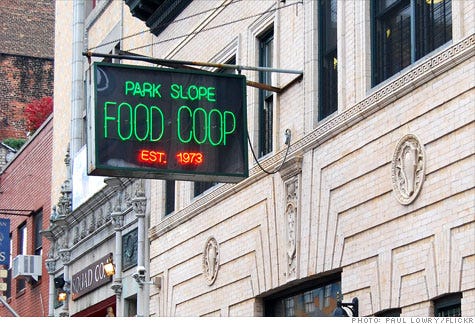
Their successes are instructive. The Park Slope Food Coop in Brooklyn, for example, has operated since 1973 and serves over 17,000 members. Its members work a few hours each month in exchange for access to low-cost, high-quality food. Many of today’s co-ops blend modern logistics with democratic governance, showing that scale and ethics are not incompatible.
So what would it take to start a modest food co-op today?
First, the numbers. A viable food co-op can begin with as few as 50 committed households. These members would each contribute an initial investment or membership fee—typically ranging from $100 to $500—to help cover startup costs. This pool of funds can go toward:
Leasing a space for distribution or storage (or partnering with a community center or church hall)
Purchasing refrigeration units, shelving, and basic equipment
Initial bulk food orders from wholesalers or local producers
Digital infrastructure, including a website, inventory system, and member communication tools
Total startup costs can range from $50,000 to $200,000, depending on the size, urban vs. rural location, and whether the co-op is starting as a buying club or a full storefront. These costs are far less daunting when shared across dozens—or eventually hundreds—of members.
The organizing process typically begins with community meetings to gauge interest and establish shared values. A core organizing group forms to handle legal registration, financial planning, and outreach. The group then drafts bylaws, sets membership terms, and creates a simple governance structure—often one-member, one-vote, with rotating roles or elected coordinators.
As operations begin, the co-op can phase in its services:
Start as a buying club, placing weekly or biweekly wholesale orders for members to pick up
Transition into a distribution hub with more regular access and a small team of staff or volunteers
Grow into a storefront or market, open to the broader public
Importantly, selling surplus goods to non-members can be a powerful model of outreach. Not only does it bring in revenue to support operations, but it introduces the co-op to a wider audience, some of whom may later choose to join. Pricing models can reflect this—slightly higher for non-members, with discounts or bonuses for those who contribute time or labor. This dual-tier structure balances inclusivity with the benefits of membership.
Some co-ops also offer solidarity memberships or sliding scale fees, ensuring that affordability isn’t a barrier to participation. The goal is not exclusion, but empowerment—and that means designing with flexibility, trust, and accessibility in mind.
Technology makes this easier than ever. Online ordering platforms, mobile inventory systems, and group communication tools can streamline logistics and governance. Partnerships with local farmers, regional food hubs, and wholesalers can ensure a diverse and stable supply chain that is not reliant on international shipping or corporate distributors.
Beyond the logistics, a food co-op is about empowerment. It shifts people from being passive consumers to active stewards of their food system. It creates a local alternative to globalized food insecurity. And it helps restore trust in what we eat, and in who we eat with.
In a world where the industrial food system is increasingly failing us, food co-ops offer something else: solidarity, sovereignty, and sustenance.
The future of food might just be a table we set ourselves.
Tiktok failed to load.Enable 3rd party cookies or use another browser