
152: The Resurgent Commons
Imagining A More Human Centered Travel Experience
Big thanks to our fellow traveler Mike Oppenheim who is now one of two members of the heroic Metaviews founders tier. We would not be able to do what we do without the support of all of you, monetary and otherwise! 😍
If the public has ended, what comes next?
In the wake of institutional collapse and ideological failure, we’re not just witnessing the death of old systems—we're living in the early days of something new. This is a moment of creative potential. Not a return to what was, but an evolution toward what could be: a resurgent commons.
The commons is not a nostalgic ideal. It’s a living, adaptive framework for collective life. Historically, commons were shared resources governed by communities—forests, pastures, fisheries, knowledge—managed through mutual agreements and sustained by relationships. They weren’t perfect, but they represented a third way between state control and private ownership.
What might a 21st-century commons look like?
Rather than simply reclaiming the past, we can design new forms of collective governance—drawing from tradition while integrating today’s knowledge about sustainability, equity, and participatory democracy. We can move beyond extractive capitalism by building systems that are resilient, accountable, and rooted in care.
Let’s imagine a bold example: a co-operatively owned airline.
Instead of being run by shareholders seeking profit, this airline would be owned by its workers, passengers, and the communities it serves. Decisions about routes, wages, sustainability goals, and ticket pricing would be made through democratic processes. The focus wouldn’t be on upselling or maximizing shareholder returns—it would be on accessibility, environmental responsibility, and good working conditions.
The passenger experience would reflect those values. Imagine boarding a plane where the seats are designed for comfort, not cramming. Where the staff are well-rested, respected, and genuinely enjoy their jobs. Meals are healthy, locally sourced, and included as a matter of hospitality. Accessibility needs are anticipated and met with dignity. There's no pressure to buy, no class hierarchy—just a shared space moving people safely and with care.
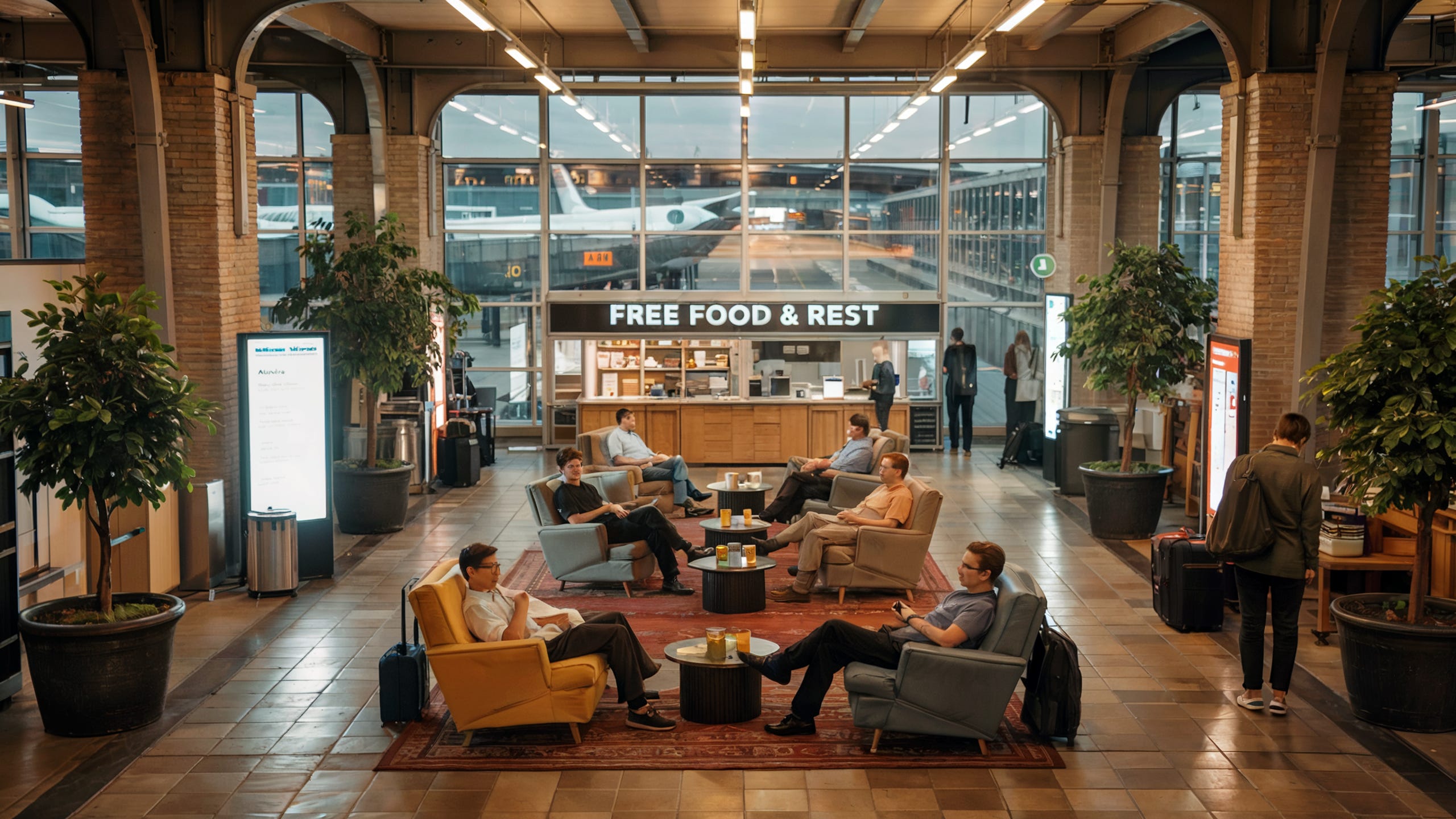
And what about the airport? Let’s imagine an anti-capitalist airport.
Rather than being designed like a mall—optimized for shopping, surveillance, and obedience—this airport would be a public space in the truest sense. There would be free transit access. Locally owned food and culture hubs instead of chain stores. Areas for rest and play, for work and collaboration. Art, not advertisements. Hospitality, not harassment.
Security would be reimagined as community safety, not militarized screening. Staff would be unionized and well-paid. Climate impact would be transparently accounted for and minimized wherever possible. The airport would feel less like a machine for extracting money, and more like an intercommunal gateway—a commons of motion.
And when the flight ends? Imagine arriving at a co-operatively owned hotel that embodies the same values.
This hotel doesn’t nickel-and-dime you. It welcomes you. The front desk is staffed by workers who are also members of the cooperative. The rooms are clean, quiet, and designed for comfort, not churn. There’s communal space for gathering, local food prepared with care, and child care and wellness services on site. Pricing is transparent and fair, rooted in a cost-sharing model rather than profit maximization. Guests are treated not as consumers, but as participants in a shared social space. Want a discount while staying, contribute labour to the upkeep, whether cleaning, cooking, or creating.
These aren’t utopian fantasies. They’re design challenges. We already have the tools—co-ops, land trusts, digital platforms, deliberative assemblies. What we need is the courage to build differently, to center human need over profit.
A resurgent commons begins where people choose to govern what matters to them—together. It starts when we stop asking how to fix the system and start building the next one.
This is not just resistance to capitalism—it’s a declaration of possibility. A public that governs itself. A future built on shared power, not private gain.
And it may start in places as unexpected as an airport gate.