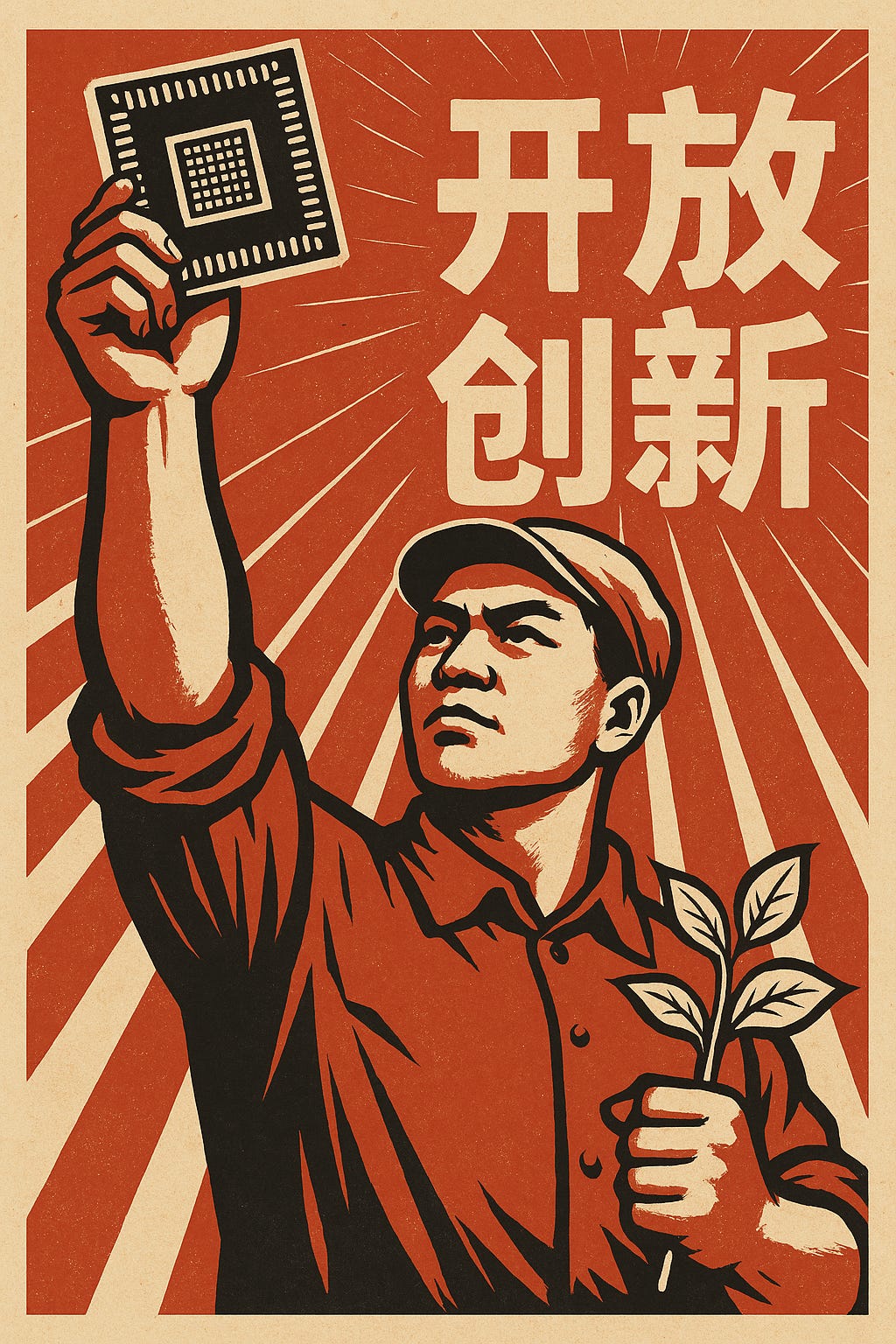
What if the most disruptive move in the global trade war isn’t a tariff—but a jailbreak?
As the United States ramps up its economic assault on China—blacklisting companies, severing supply chains, and weaponizing the dollar—it’s easy to forget that America’s greatest export isn’t oil or semiconductors.
It’s intellectual property.
Copyrights, patents, trademarks. The very idea that an idea can be owned. These legal fictions form the spine of the U.S.-led global economy.
But what if China decided it no longer wanted to play along?
Intellectual Property as Imperial Infrastructure
For decades, the U.S. has enforced global IP laws through trade deals, lawsuits, and international bodies like the WTO and WIPO. Compliance with this regime has been a prerequisite for access to Western markets—and a powerful lever of control.
But that compliance is fraying.
As economic hostilities escalate, Chinese strategists are reportedly considering a bold move: unilaterally exiting the global IP system. No more recognition of U.S. copyrights, patents, or trademarks. No more licensing fees or royalty payments. Instead: a pivot to open innovation—a model where ideas flow freely, knowledge is shared, and technological sovereignty is reclaimed.
Not piracy. Policy.
Here’s Why It Would Work
Scale: China already has the industrial capacity and technical expertise to domestically reproduce and iterate on global technologies.
National security: Decoupling from Western IP restrictions allows China to rapidly develop sensitive technologies, from AI to biotech to defense systems.
Soft power: By sharing open technologies with the Global South, China could become the champion of a new developmental model—less extractive, more collaborative.
Think of it as a reverse Marshall Plan: not cash and infrastructure, but open-source tools and liberated knowledge.
There are two examples that are obvious and have immediate impact:
Media: Collapse of the Franchise Empire
Hollywood has long depended on global IP enforcement to protect its monopolies. But what happens when China no longer recognizes your copyrights?
Unlicensed sequels and remixes of Marvel, Star Wars, and Disney properties, made at a fraction of the cost.
AI-generated mashups of global content, broadcast freely across Chinese and emerging markets.
New genres born from cultural synthesis, rather than corporate ownership.
What the West might call theft, a new generation might call freedom. This is storytelling unshackled—where the global imagination is no longer fenced in by licensing deals.
Agriculture: Breaking the Seed Monopoly
Few sectors are as tightly bound by IP as industrial agriculture. From patented seeds to proprietary software and sensor networks, farmers are trapped in closed ecosystems.
An open innovation model would change that:
Unpatented seeds—climate-resistant, high-yield—mass-produced and distributed globally.
Open-source farm tech, from drones to tractors, shared freely and manufactured locally.
AI tools for precision farming, built collaboratively and trained on open datasets.
This wouldn’t just disrupt Big Ag. It could empower farmers around the world, enabling food sovereignty and resilience in the face of climate collapse.
How the World Might React
The U.S. would retaliate. Lawsuits, sanctions, WTO complaints. But enforcement would be difficult—especially if other countries began to defect from the IP order.
India could scale up its generics industry.
Brazil and South Africa could build sovereign tech ecosystems.
Southeast Asia and Africa could leapfrog into a post-IP economy—fueled by collaboration, not restriction.
In a fragmented world, open innovation may be not just a strategy—but a survival mechanism.
What About Canada?
If Canada has any geopolitical vision, this is our opportunity.
Rather than clinging to the collapsing U.S. order, we could:
Become a neutral broker in a new open innovation bloc.
Leverage public institutions to build tools and technologies that are globally accessible.
Decriminalize creativity by reforming IP law and protecting cultural remix and public knowledge.
Empower farmers and small businesses to access global designs and tools without legal gatekeeping.
We could even become a refuge for creators and researchers fleeing increasingly repressive IP regimes.
Open innovation isn’t just a policy choice. It’s a values choice.
The trade war is not just about markets. It’s about models.
If China breaks the global IP system, it won’t be a glitch. It will be a glimpse of the future: one where the right to innovate is not gated by multinational corporations, but shared by all.
The end of IP may feel chaotic—but it could also mark the beginning of a more just, creative, and open world.
If we’re bold enough to seize it.