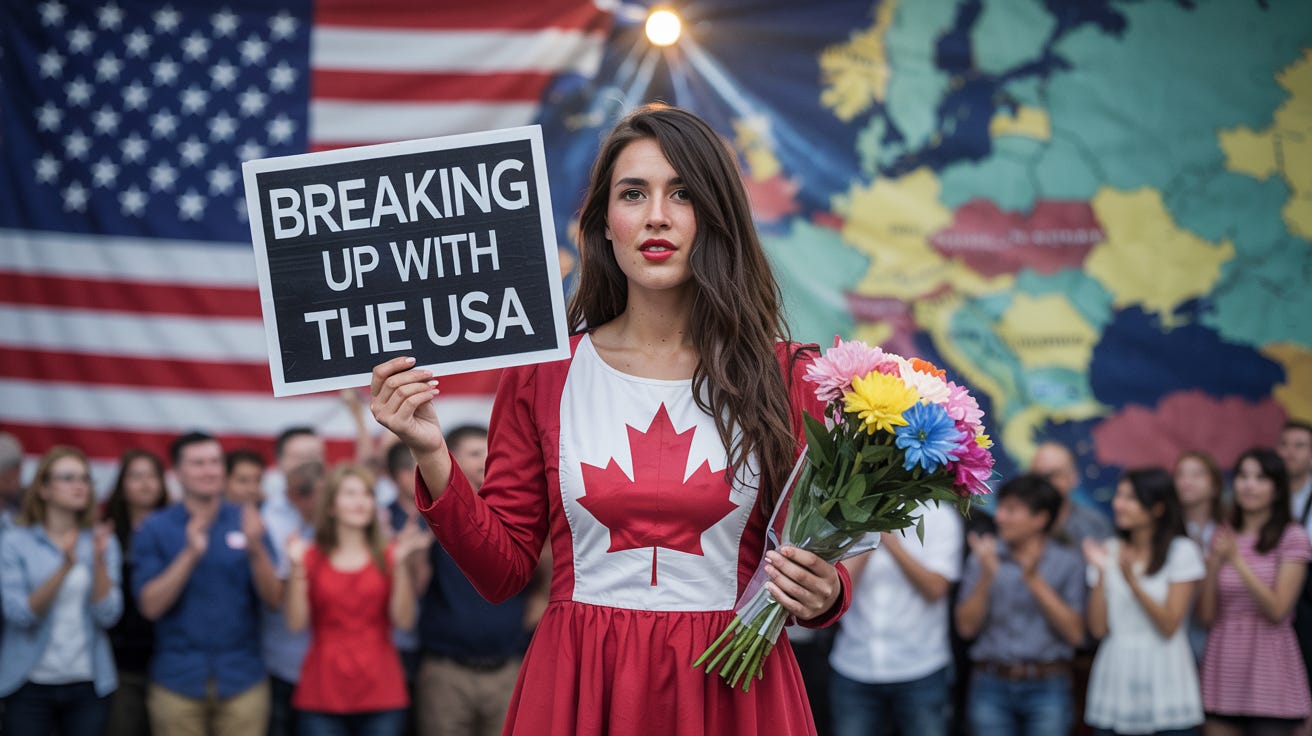
There’s a pattern here—one we’re taught not to see.
When Donald Trump lashes out at Canada and the European Union for deepening ties, he’s not just acting as a petty nationalist. He’s performing an all-too-familiar role: the jealous, possessive partner who would rather burn it all down than see you move on without him.
In his latest tantrum, Trump is threatening place tariffs on Canadian and European goods, specifically targeting autos, aerospace, and clean tech—sectors critical to their collaborative economic future. Why? Because they dared to explore relationships that don't center the United States. Because they are asserting independence. Because, in Trump’s eyes, they are cheating.
This isn’t diplomacy. It’s coercive control.
And like so many toxic relationships, it escalates when the other party asserts boundaries.
Trump’s aggression fits the pattern of what experts call intimate partner violence (IPV). It may seem unusual to apply that framework to international relations, but the parallels are stark:
Isolation: Trump has long sought to weaken multilateral institutions—NATO, the WTO, the UN—preferring one-on-one deals where he can dominate.
Economic abuse: Tariffs and trade threats are wielded like financial punishment—cutting off access, sabotaging plans, forcing dependency.
Gaslighting: Trump accuses Canada and the EU of betrayal, even as he undermines their sovereignty and cooperation.
Escalation: The more independent they become, the more he lashes out, raising the stakes and threatening broader harm.
What if we stopped treating this behavior as strategy and started calling it what it is—abuse?
The epidemic we ignore
IPV is not rare. It is a public health crisis—a pandemic that thrives in silence and denial. Globally, nearly 1 in 3 women have experienced physical or sexual violence by an intimate partner. In the U.S., over 10 million people suffer IPV each year, across all genders. And behind each statistic lies a culture that tolerates coercion, enables abusers, and blames survivors.
The tools of IPV are not always physical. They’re economic, psychological, emotional. They operate through fear and dependence. And they flourish in systems where power is hoarded and hierarchy is normalized.
Which is why we should see Trump’s behavior not as an exception, but as a mirror. His political instincts are not foreign to our society—they are its exaggerated form. The possessiveness, the need to dominate, the threats when someone tries to leave—this is not just Trump. It is patriarchy. It is white supremacy. It is empire.
And if we fail to call it out, we normalize it. We let it slide. We mistake it for strength.
From survival to solidarity
Canada, under Prime Minister Mark Carney, is beginning to recognize this dynamic. In response to Trump’s threats, Carney has spoken of “a new era” in Canada–U.S. relations, one in which independence and multilateralism take priority. He’s suggested moving away from U.S. defense deals, including reconsidering the long-standing reliance on American fighter jets. That’s not just strategy—it’s survival.
But moving on means more than cutting ties. It requires a cultural shift.
As with survivors of IPV, leaving is just the beginning. The real challenge is healing from the relationship and learning new ways to relate—to self, to power, to others. The same is true of our geopolitical reality. If we want a world where authority is earned, not imposed—where autonomy is respected, not punished—we need to build institutions and norms that reflect those values.
And we need to stop rewarding bullies.
Because Trump’s tactics work when people back down. When they fear retaliation more than they value freedom. When they believe the abuser’s version of events.
What the world needs now—what Canada and the EU are cautiously modeling—is solidarity. A recognition that healthy relationships, personal or political, are rooted in mutual respect and shared flourishing.
Trump wants to make the world afraid again.
But maybe, just maybe, we’ve seen this play before.
And this time, we’re walking out.