This room cost $2,000 a month
You can believe it, man, it's true
Somewhere there's a landlord's laughing till he wets his pants
No one dreams of being a doctor or a lawyer or anything
They dream of dealing on the dirty boulevard
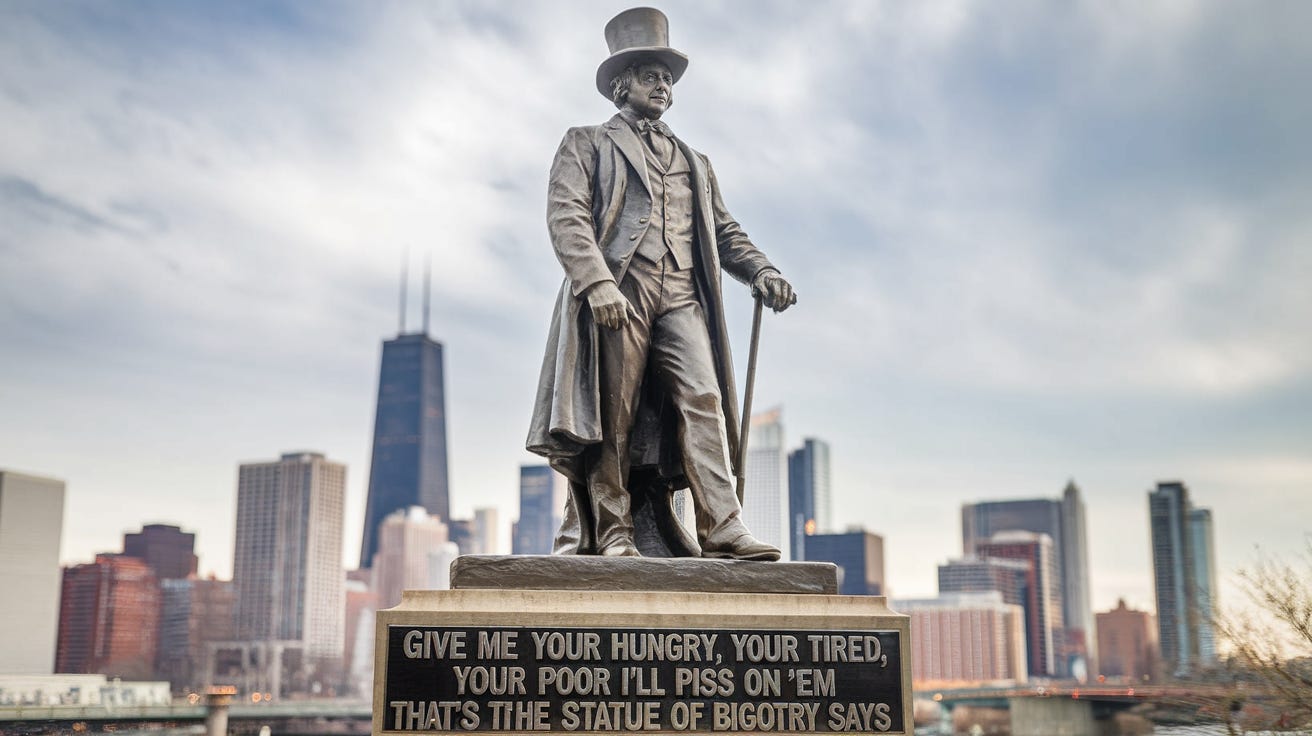
Give me your hungry, your tired, your poor I'll piss on 'em
That's what the Statue of Bigotry says
Your poor huddled masses
Let's club 'em to death
And get it over with and just dump 'em on the boulevard
Disinformation and deception are often discussed in the context of the political right—fake news, propaganda, and conspiracy theories designed to undermine democracy and rational discourse. But deception is not exclusive to right-wing politics. If anything, the dominant ideology of our time—liberalism—claims the moral high ground while quietly failing to deliver on many of its core promises. Liberalism presents itself as a rational, just, and progressive framework for governance, but its contradictions and failures are evident in widening inequality, political instability, and environmental collapse.
The collapse of trust in institutions is not simply the result of populist manipulation but a response to real betrayals. People sense the gulf between what they were told liberalism would bring—freedom, prosperity, and fairness—and the reality they experience—stagnation, corruption, and deepening crisis. Neoliberalism, the contemporary form of economic liberalism, has accelerated these failures, concentrating wealth and power in the hands of a few while demanding austerity and sacrifice from the many.
Yet, instead of acknowledging these failures and seeking alternatives, mainstream discourse insists that liberalism is the only viable political and economic system. Criticism of its shortcomings is dismissed as either extremist or naive. But what if we took these criticisms seriously? What if we admitted that liberalism has failed to live up to its own promises? Only by doing so can we imagine something better beyond it—something that prioritizes collective well-being over corporate profits, real democracy over elite rule, and sustainability over endless growth.
To break free from the falsehoods of (neo)liberalism, we must first identify them. Here is a list of the lies and false promises of liberalism, spanning from its classical roots to its neoliberal present.
1. Economic Growth Benefits Everyone ("Trickle-Down Economics")
Promise: When the economy grows, everyone prospers. Wealth created at the top eventually "trickles down" to the rest of society.
Reality: Wealth accumulation benefits the elite, while wages stagnate, inequality deepens, and essential services are cut. Economic growth is often achieved at the cost of worker exploitation, environmental degradation, and financial speculation.
2. Free Markets Lead to Innovation, Competition, and Efficiency
Promise: A free market fosters competition, which leads to lower prices, better products, and economic efficiency.
Reality: Markets tend toward monopoly and corporate consolidation. Large corporations crush competition, extract wealth, and lobby for regulations that benefit them while preventing real competition.
3. Privatization Improves Services
Promise: The private sector runs services more efficiently than the public sector.
Reality: Privatization often leads to higher costs, lower quality, and reduced access. Essential services like healthcare, education, and utilities become profit-driven, prioritizing shareholders over the public good.
4. Deregulation Spurs Economic Growth and Prosperity
Promise: Removing government regulations allows businesses to thrive, creating jobs and wealth.
Reality: Deregulation often results in economic crises, financial fraud, worker exploitation, and environmental destruction. The 2008 financial collapse is a direct result of deregulated banking.
5. Globalization Benefits All Nations
Promise: Free trade and globalization raise living standards worldwide.
Reality: Globalization primarily benefits multinational corporations. It devastates local industries, exploits cheap labor, and allows corporations to move capital freely while restricting workers' rights and wages.
6. Austerity Ensures Economic Stability
Promise: Cutting public spending strengthens the economy and prevents debt crises.
Reality: Austerity measures weaken social safety nets, increase poverty, and slow economic recovery. Wealthy individuals and corporations are rarely forced to make sacrifices, while the burden falls on ordinary citizens.
7. Financial Markets are Rational and Self-Correcting
Promise: Markets, when left alone, will efficiently allocate resources and correct failures.
Reality: Financial markets are driven by speculation, greed, and short-term gains. They create booms and busts, leading to instability and economic crises.
8. Individual Responsibility Overcomes Systemic Inequality
Promise: Hard work and personal responsibility determine success, regardless of background.
Reality: Systemic barriers such as class, race, and gender inequality create vast disparities in opportunity. The "self-made" narrative ignores inherited privilege and the structural advantages of the wealthy.
9. Consumer Choice Equals Freedom
Promise: More choices in the marketplace empower individuals and increase freedom.
Reality: Consumer choices are manipulated through advertising, monopolistic control, and planned obsolescence. Essential needs like healthcare and housing should not be commodities subject to market forces.
10. Lower Taxes Lead to Economic Prosperity
Promise: Cutting taxes—especially for corporations and the wealthy—leads to job creation and investment.
Reality: Tax cuts primarily benefit the rich, leading to budget deficits and reduced public services. Instead of reinvesting, corporations often use tax cuts for stock buybacks and executive bonuses.
11. Free Trade Promotes Fairness and Economic Growth
Promise: Trade agreements create a level playing field, benefiting all nations.
Reality: Trade agreements prioritize corporate interests, weaken labor protections, and allow multinational corporations to challenge national laws that interfere with profits.
12. Economic Growth Solves Environmental Problems
Promise: Innovation and economic growth will solve climate change and resource depletion.
Reality: Capitalist economies prioritize short-term profit over sustainability. Economic expansion often leads to environmental destruction, with little corporate accountability.
13. The Gig Economy Provides Freedom and Flexibility
Promise: The rise of freelance, gig, and contract work gives people independence.
Reality: The gig economy strips workers of rights, benefits, and job security while shifting risks onto individuals. Companies like Uber and Amazon exploit labor without providing stability.
14. Education is the Key to Success and Social Mobility
Promise: Investing in higher education ensures upward mobility.
Reality: Higher education has been commodified, leading to massive student debt and overqualified workers in precarious jobs. Elite institutions reinforce class barriers through high tuition and exclusive networking opportunities.
15. Capitalism and Democracy Go Hand in Hand
Promise: Free markets and democracy reinforce each other, leading to greater political and economic freedom.
Reality: Wealth concentration undermines democracy, as corporations and billionaires manipulate politics through campaign financing, lobbying, and media control. The result is oligarchy, not democracy.
16. Free Speech and the Marketplace of Ideas Ensure Truth Prevails
Promise: Open debate in a liberal society ensures that truth and justice emerge.
Reality: The wealthy and powerful dominate public discourse through corporate media, think tanks, and political lobbying. Misinformation and propaganda often overpower truth.
17. Property Rights Protect Freedom
Promise: Protecting private property ensures personal liberty and economic stability.
Reality: Property laws have historically legitimized colonialism, land theft, and wealth hoarding. Wealthy landowners benefit while renters and the landless remain economically trapped.
18. Unions and Collective Bargaining Hurt Economic Growth
Promise: Unions distort labor markets and drive businesses away.
Reality: Strong unions correlate with higher wages, better working conditions, and more stable economies. Attacks on unions have led to lower wages and job precarity.
19. Wealth is a Sign of Merit and Industry
Promise: The rich are wealthy because they are industrious, intelligent, or provide value to society.
Reality: Wealth is often inherited or accumulated through financial manipulation, exploitation, and political influence rather than innovation or hard work.
20. Rising GDP Equals National Well-Being
Promise: A growing economy means a better quality of life.
Reality: GDP measures economic activity, not well-being. Economic growth can occur alongside worsening inequality, environmental degradation, and social unrest.
21. Military Interventions Promote Freedom and Stability
Promise: Liberal states use military force to spread democracy and protect human rights.
Reality: Military interventions serve corporate and geopolitical interests, destabilizing regions and causing humanitarian crises.
22. Financialization Strengthens the Economy
Promise: Expanding financial services strengthens economic stability.
Reality: Financialization turns the economy into a casino, where profits are made through speculation rather than productive investment, leading to crashes and instability.
23. The Future Will Always Be Better Under Liberalism
Promise: Economic liberalization ensures constant progress and human advancement.
Reality: Rising inequality, climate disasters, mental health crises, and democratic backsliding suggest otherwise. Many crises today are a direct result of liberal economic policies.
Final Thought
Liberalism markets itself as a system of individual freedom, economic prosperity, and rational governance. Yet, in practice, it consolidates power among elites, exploits labor and resources, and justifies inequality under the guise of progress.
By recognizing these contradictions, we can begin to explore alternatives that prioritize collective well-being over corporate profit, real democracy over elite rule, and sustainability over endless growth. It’s time to stop defending a system that has failed to deliver on its own promises and start imagining something better beyond liberalism.