
80: A Rare Moment of Synthesis
The Dialectic Resets
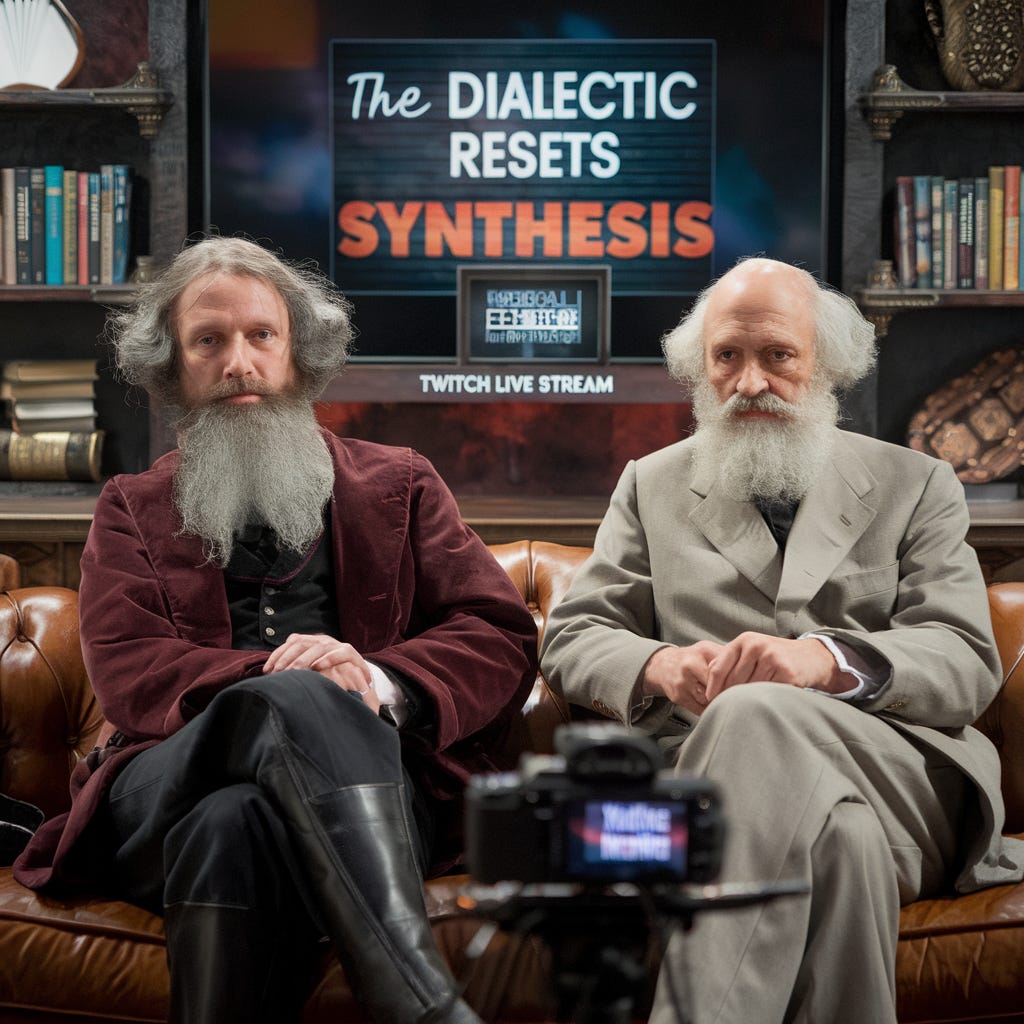
Reminder that tomorrow at 3pm we’re hosting a salon on the topic of the future of social media, with a focus on what would make it better. To RSVP and get the link please post a comment on this post…
We’re living in the midst of a rare and extraordinary moment—a point of synthesis where the dominant narrative is beginning to reset. History, viewed through the lens of Hegel’s dialectics, tells us that ideas emerge, are opposed, and eventually merge into new paradigms. This process is often slow, messy, and imperceptible in real time. But occasionally, there’s a sharp pivot—a moment of reckoning that signals the collapse of the old and the birth of something new.
Right now, we’re witnessing one of those moments.
What are Hegel’s Dialectics?
At its core, Hegel’s dialectics are a way of understanding historical and social change through contradictions and their resolutions. It works like this:
Thesis: An idea, system, or dominant narrative emerges.
Antithesis: This thesis generates its opposite—an opposing force or idea that challenges the status quo.
Synthesis: From the tension between the two, a new idea or system emerges, incorporating elements of both the thesis and antithesis.
This isn’t just a cycle; it’s a spiral. Each synthesis becomes a new thesis, prompting a fresh wave of contradictions and resolutions. Over time, these iterations drive transformation—of societies, economies, and ideas.
The Rise and Fall of the Neoliberal Thesis
For the last half-century, neoliberalism and globalization have dominated as the thesis. This system sold us a world where markets knew best, borders were porous for capital (sometimes people), and progress was defined by growth at all costs. The antithesis came in two forms:
The Authoritarian Nationalist Reaction: A rising tide of strongmen and movements that rejected globalism in favor of borders, control, and a nostalgic appeal to imagined pasts.
The Radical Community Countermovement: Grassroots social movements, decentralized communities, and networks rejecting neoliberal individualism in favor of mutual aid, cooperation, and ecological harmony.
For the last decade, these forces collided with ever-increasing intensity. Brexit, Trump, Bolsonaro, and the far-right ascendance represented one pole, while climate strikes, mutual aid networks, and digital social movements represented the other.
But now, the synthesis is here.
A New Synthesis: AI Nationalism
The collapse of neoliberalism is the thread binding our moment together. The pandemic, the supply chain crisis, and the hollowing out of trust in institutions revealed its fatal flaws. Markets couldn’t protect us, growth failed to translate into well-being, and globalization has proven brittle in the face of shocks.
This collapse doesn’t mean the end of neoliberal logic—corporate power and financial interests still loom large—but its ideological dominance is over. The world is no longer run on the assumption that "there is no alternative." (Memo to Mark Carney).
This synthesis has birthed a strange new moment. Authoritarian nationalism is no longer a reaction; it is fast becoming the new thesis, reshaping governance around control, surveillance, and populist rhetoric. We’ll call it AI Nationalism, as it combines technology with austerity, and targeted marketing with conspiracy.
Meanwhile, the antithesis—grassroots social movements and radical approaches to innovation—continue to resist, with tactics and strategies evolving in response to this new terrain.
We’ve had glimpses of this presently as the TikTok shutdown displaces Americans, sending them to RedNote, where solidarity, connection, and language lessons are fostering good will. So much so that now RedNote is worrying about US influence.
What Can We Learn from This Synthesis?
The Limits of Markets: The neoliberal promise that markets could solve social problems has been thoroughly debunked. Housing crises, climate collapse, and public health failures highlight the need for collective action and reimagined governance.
A New Polarization: The global order is no longer divided between globalists and nationalists but between centralizers (authoritarian states) and decentralizers (grassroots communities). This shift reframes political conflict as a contest over autonomy and control rather than borders and economies.
Crisis as Catalyst: The synthesis we’re in is fueled by Polycrisis—climate disasters, economic inequality, and technological disruption. These crises aren’t aberrations; they’re structural features of the new paradigm.
If this synthesis represents the death of neoliberalism, what might emerge from its ashes? Here are a few possibilities:
Authoritarian Nationalism Fully Consolidates: The thesis becomes entrenched as states prioritize control, suppression of dissent, and technological dominance.
Radical Decentralization Grows: Social movements and networks refine their strategies, embracing technologies like decentralized AI, open protocols, and distributed governance to build parallel systems of power.
A New Global Vision: Out of the ashes of neoliberalism, there is a chance for a new synthesis that redefines collective well-being—centered on planetary solidarity, cooperative economics, and post-scarcity possibilities.
The key question is timing. How long will the current synthesis last before the contradictions within authoritarian nationalism reveal its limits? And will grassroots movements be ready to seize the moment when it comes?
The reset of the dialectic is both an opportunity and a warning. The death of neoliberalism opens space for something new, but it’s far from guaranteed what will fill the vacuum. Moments of synthesis are fragile and fleeting. They require us to think strategically and act collectively, not just to resist the new thesis but to envision and build a better one.
As the dialectic resets, the future of authority is wide open—but it will be shaped by those bold enough to imagine what comes next.