Goats and Leadership
Fostering Talent in Diverse Teams
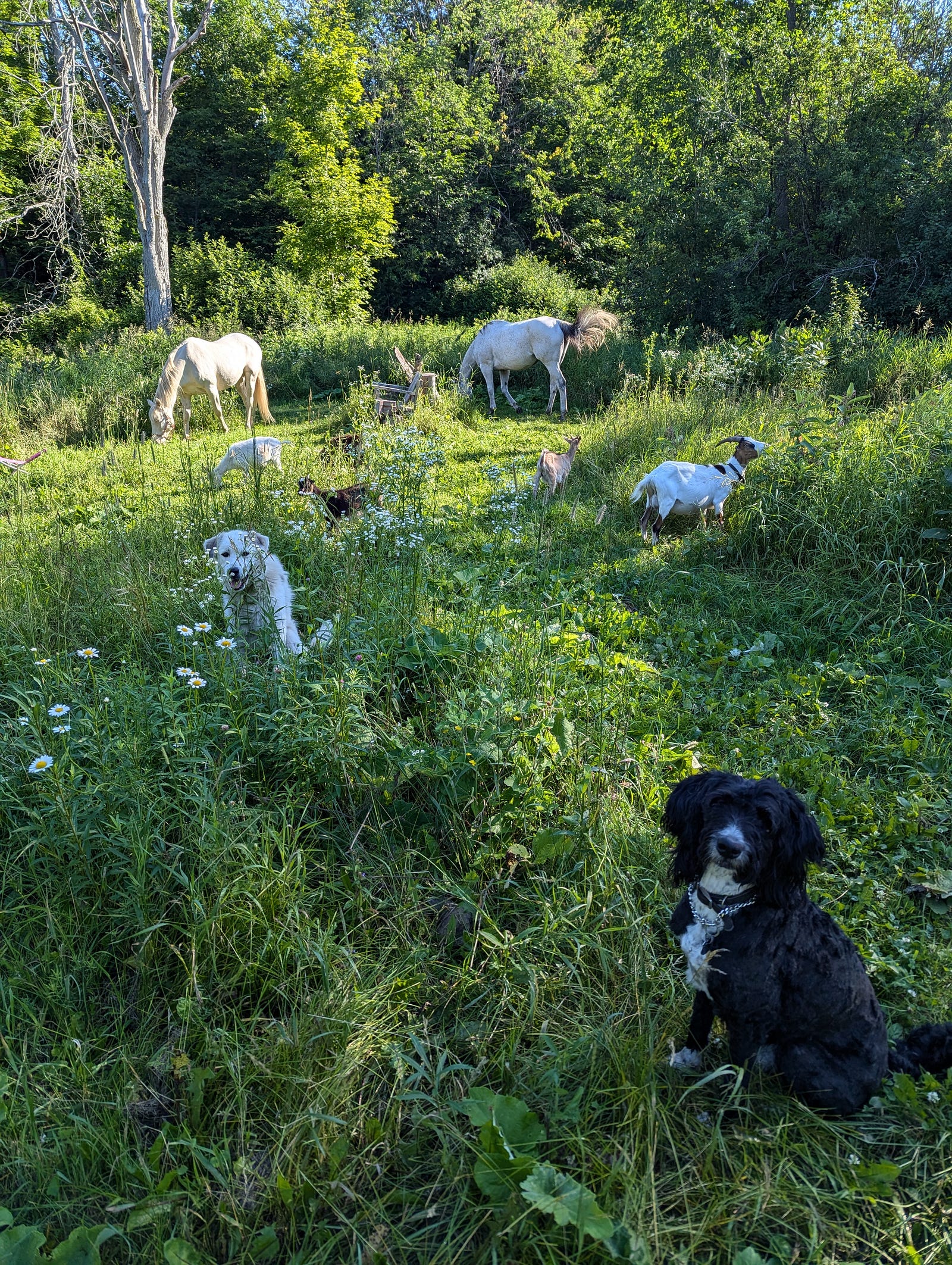
I’d like to share a story about goats, dogs, and horses. About leadership, talent, and diverse teams. How to get a motley crew to work together and make life easier, or in the business context, accomplish complex tasks.
The back of our property has the best food for our animals, but it is far from the barn, and unfenced. Similarly it’s a diverse ecosystem, and can’t be easily processed into something like hay. Hence the best way to utilize it is to bring the herd to it, and allow them to graze in a manner that contributes to rather than disrupts the thriving life.
In order to manage this task, I had to come up with a plan that included our dogs, goats, and horses, in addition to minimal labour, risk, and danger. Bonus points if it could be enjoyable, and a learning experience for all involved.
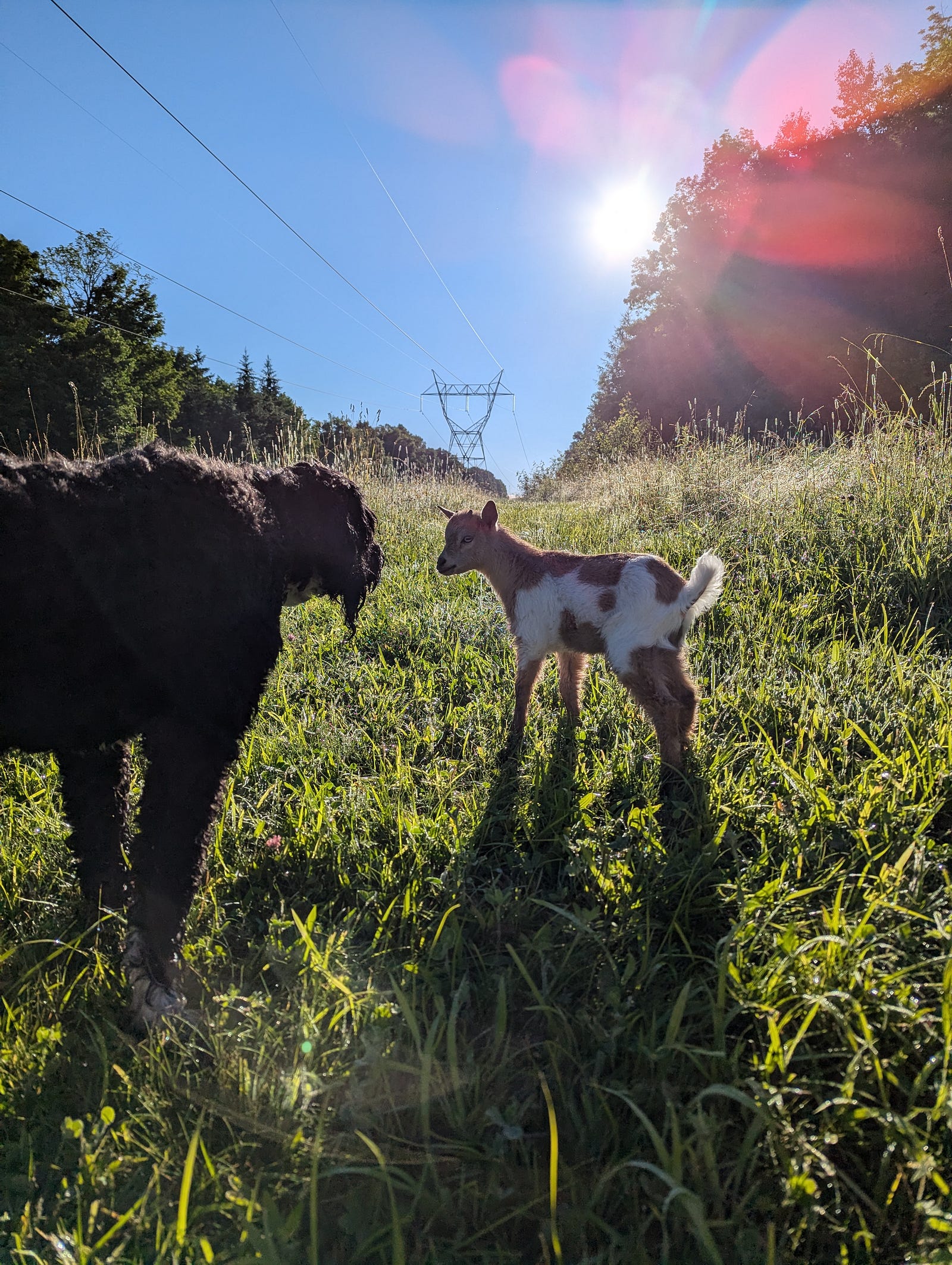
I began with the dogs. Together we came up with a circuit that reflected the places they wanted to sniff and pee, and the places I wanted to rest and observe. We then repeated this circuit for a few weeks as per our usual walks.
Then came the goats. Not an easy group to lead. Goats embody defiance and independence. They like what they like and tend to do what they want to do. However like dogs, they are food motivated, and respond positively to a leader who always has treats in their pocket.
Similarly leadership within goat herds can be dynamic and in our case divided. Our herd essentially has three clans, or cliques, in addition to differences in age and sex. This means I can’t treat the herd as a united whole, but have to integrate these dynamics into my leadership strategy.
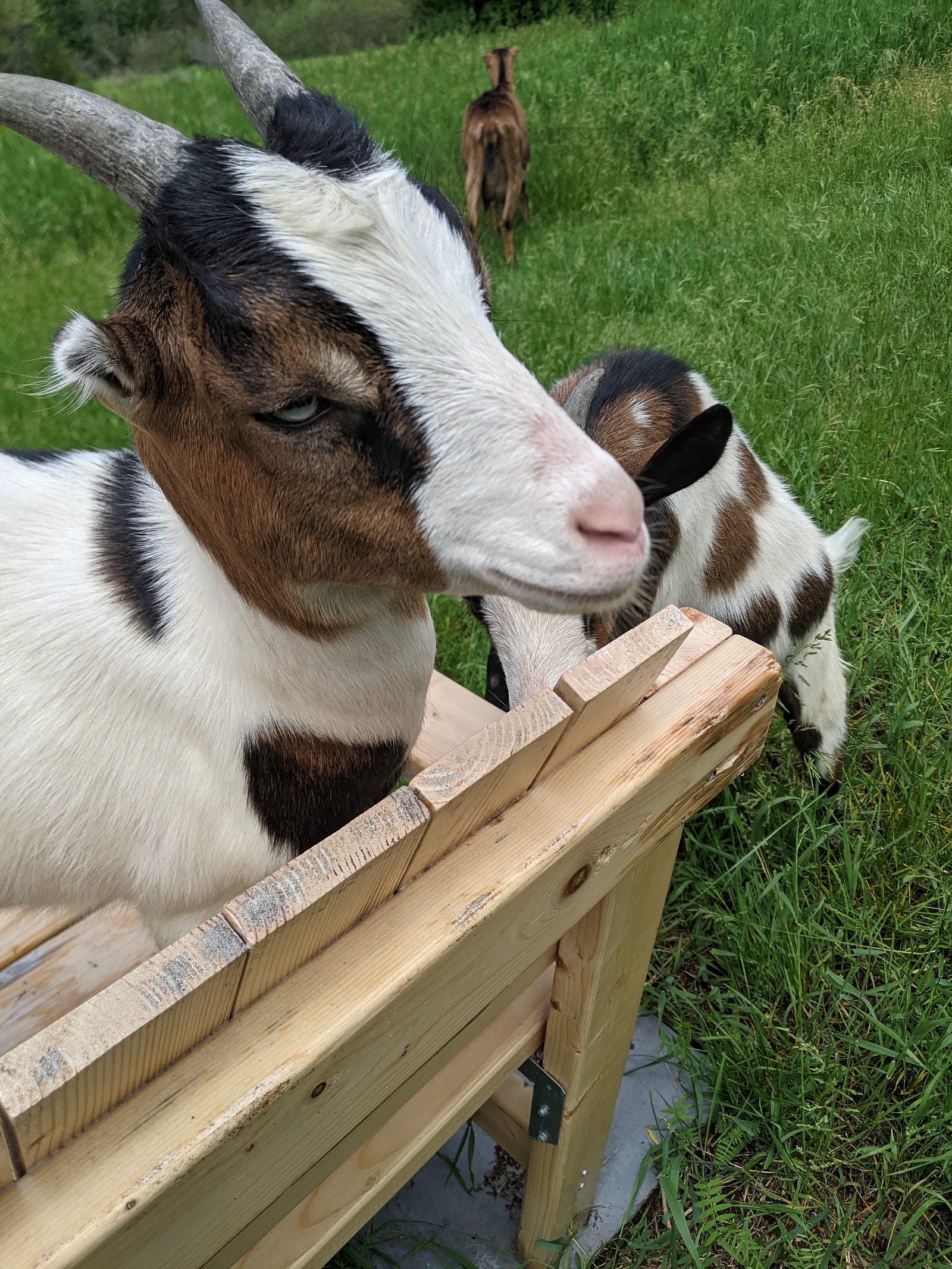
So I started with Ella, the leader of the largest clan, and a goat who’s leadership I’ve been actively investing in. Almost every time Ella runs to me I give her a treat. More than any other goat, she knows I’m good for it. So her clan were the first to be added with the dogs to our walks, as Ella will always go where I go, and be rewarded accordingly. Her kids, siblings, and nieces all follow.
After bringing Ella’s clan on the circuit for several days in a row, they get the rhythm of the walk, and find it easy to follow the dogs who insist on simultaneously leading and following the herd. We’re now ready to include the other goats.
The primary challenge on these walks is not just keeping everyone together, but ensuring that all make it there. The walk from the barn to the promised land where food is bountiful goes through a forest that can be scary and full of biting bugs. If you don’t know what awaits you at the destination, it is easy to be distracted by food that is near the barn but not as good. Which is why momentum is crucial.
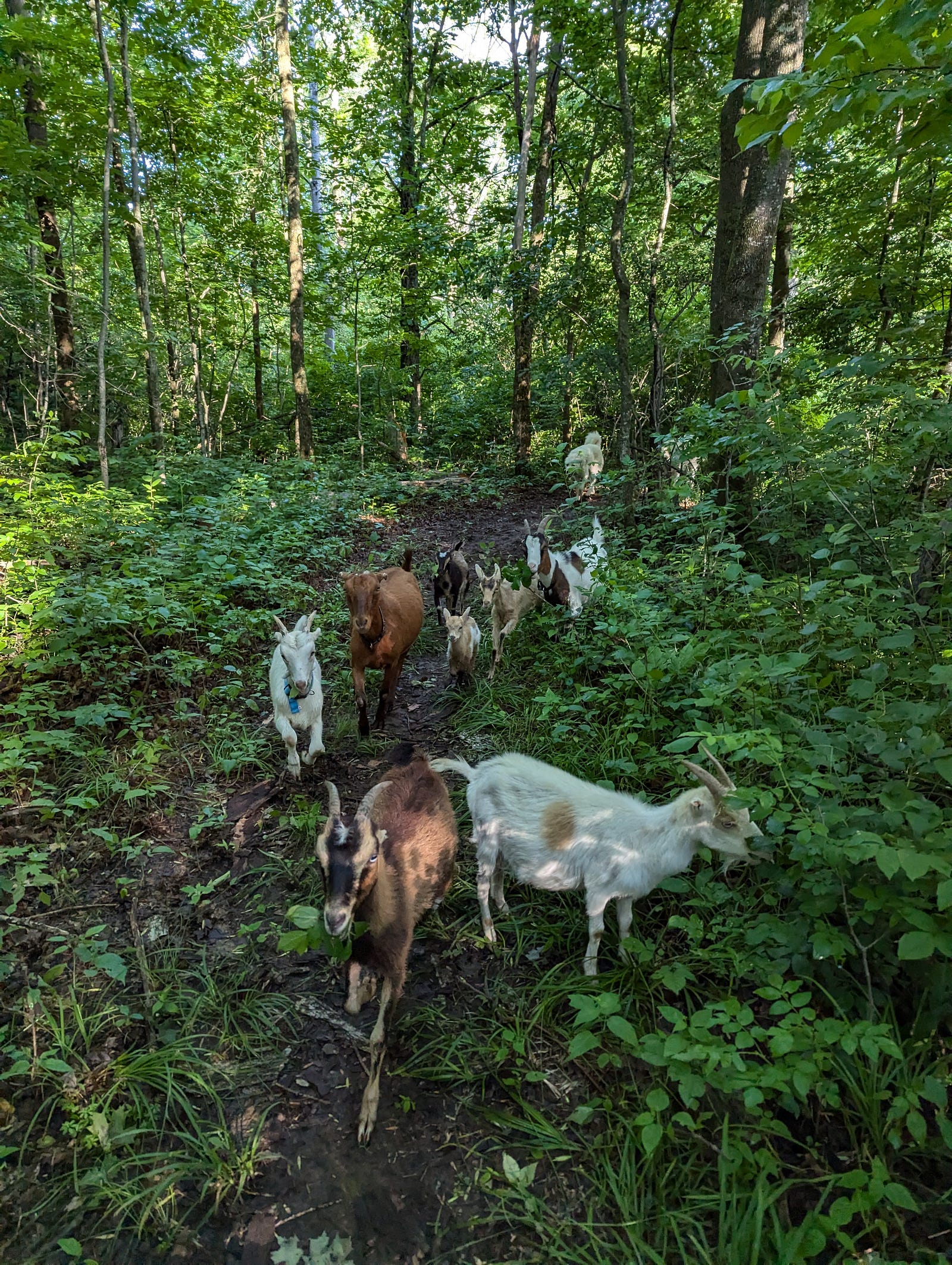
This is where Ella’s leadership is important. I can walk as fast as I want, and she will keep up, as she knows that doing so earns her rewards. Other clan leaders pick up on this and rush to match my stride and appear on my side where they also get rewarded with a treat from my pocket. Madge, our largest goat, will even go so far as to stick her head in my pocket in an attempt to score more.
The dogs are always happy to run ahead, helping lead the way, making sure all learn the circuit, and when the herd decides it is time to head barnward, the dogs do their duty to lead us all on the right path.
With dogs and goats working together, the next level is to add the horses, which increases complexity and danger. Horses have a tendency to increase momentum and anxiety. As herd animals they like to go fast, and they’re easily startled. They can also have conflicts with either the dogs or the goats over food or just attention from me. Yet what I want is for all of them to get along, so we can have our walk while eating good food (like wild raspberries).
Taking the horses to the back on their own has been inconsistent, as being far from the barn increases their stress level. My hope was that being with me and a larger herd would help.
As with the goats, this was partially an issue of leadership within the horse herd. However with horses it’s inverted. I gave Ella the goat my attention because she was the leader, however with the horses, I gave my attention to Isadore precisely because he wasn’t.
I knew that Zhen, who is the stronger and more dominant horse, would follow me and look for treats without much effort on my part. Isadore on the other hand is far more insecure, lower in the feeding hierarchy, and more likely to take off randomly, away from the herd, in search of food (and freedom from Zhen’s bullying). So I let Zhen go free while I take Isadore on a lead. The goats then follow us, with the dogs providing their usual perimeter protection.
The first few times with the horses were kind of hectic, as the goats were fearful and hesitant to get close. However once everyone understood the program, a fantastic rhythm formed where we all work together as a group.
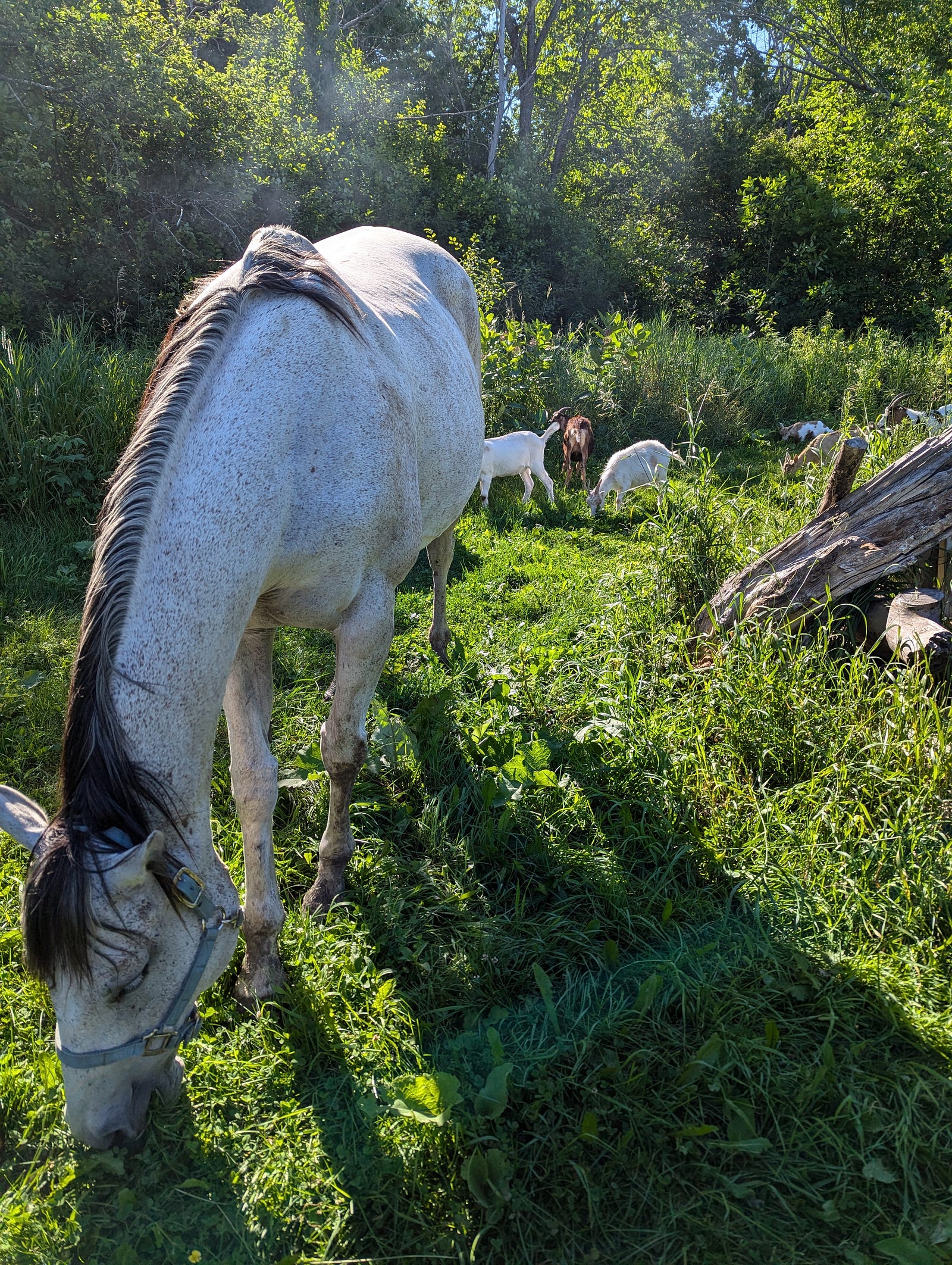
My role as herd leader is to oversee the group, provide safety, coordination, and ultimately direction. However to accomplish this I’m aggregating individual animal desires. Where the dogs want to go. What the goats want to eat. How the horses are feeling. I’m responding to individuals and allocating my attention accordingly, however I’m also investing in other leaders who can accomplish what I want without me having to do it. I teach them, they tech their kids.
The collective consciousness that emerges as part of this practice and experience is truly inspiring and intoxicating. It speaks to what is possible when you develop and combine talents amongst a diverse crew in pursuit of a common goal.
Each walk we take is different, yet each builds off the success and lessons of the past. Summers of abundance inevitably end, but the work we’re doing as a team leaves an impact, especially given the landscaping work I have this crew doing.
Through all of this I’m developing my interspecies communication skills, my leadership skills, and of course deepening my love of animals. I’m also actively developing leadership and talent among non-humans, which is remarkably rewarding, but also entirely relevant when it comes to working with people.
This is the kind of story I love sharing as part of my public speaking, consulting, and media work. It offers a framework for talent development, collaboration, and diverse leadership.